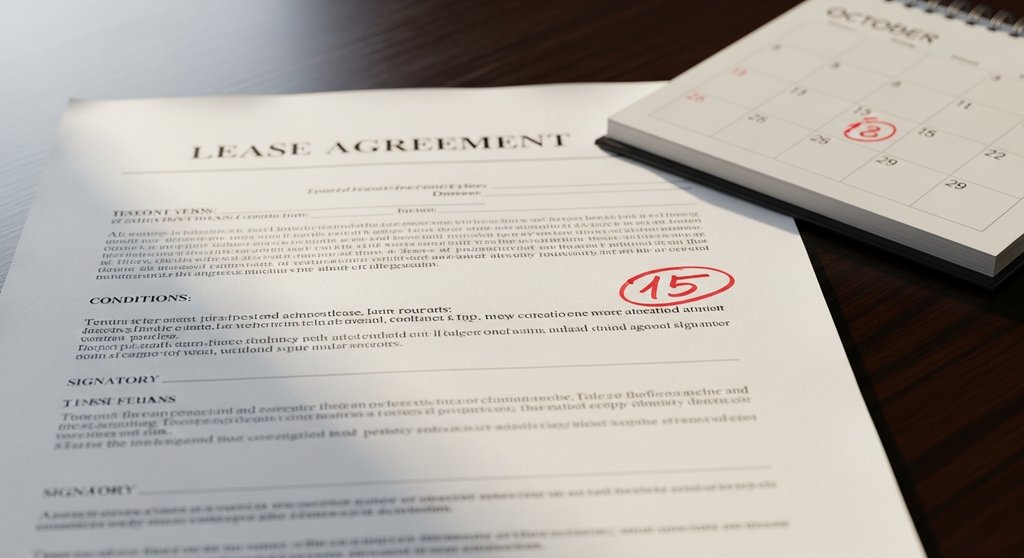
How Many Days Until Your Lease Ends? The Math Matters
A lease that ends 'in three months' is not a real deadline. Landlords, contracts, and courts care about exact days, and a single miscount can cost you a security deposit or trigger an automatic renewal you never wanted.
Why Counting Days in Your Head Breaks Down Across Months
Mental math quietly assumes every month has 30 days. It does not. January, March, May, July, August, October, and December have 31 days; April, June, September, and November have 30; February has 28 or 29. Stack a few months together and your rough estimate drifts by several days in the wrong direction.
Say your lease ends on September 12 and today is June 12. You might guess that is exactly 90 days because it feels like three clean months. The real answer is 92 days, because June through September includes two 31-day months. A two-day error sounds trivial until it is the difference between meeting and missing a notice deadline.
Leap years add another trap. If February 29 falls inside the span you are counting, you gain an extra day that no monthly shortcut accounts for. The only reliable approach is to count the actual calendar days rather than rounding each month to a tidy number.
Inclusive Versus Exclusive Counting Changes the Answer
There are two legitimate ways to count a span, and they disagree by one day. Exclusive counting measures the gap between two dates: from June 1 to June 8 is 7 days. Inclusive counting counts both endpoints, so that same span becomes 8 days if you count June 1 itself. Try the date difference calculator to see your own numbers.
Leases and legal notices often use inclusive language like 'within 30 days, including the date served.' If your notice period starts June 1 and runs 30 inclusive days, the last valid day is June 30, not July 1. Read the contract's exact wording before you count anything, because the document decides which method applies.
Banks, courts, and government offices each have their own conventions. A filing deadline measured in business days skips weekends and holidays, which can stretch a 10-day window across two full weeks. Knowing whether a deadline counts calendar days or business days is as important as the number itself.
How a Missed Notice Deadline Costs Real Money
Many leases require 60 days' written notice before the end date, or the lease renews automatically. If your lease ends August 31 and you give notice on July 5, you have only 57 days. That three-day shortfall can lock you into another full term worth thousands of dollars in rent you never planned to pay.
Security deposit return rules also run on precise day counts. A state might require the landlord to refund your deposit within 21 days of move-out. Knowing the exact return date tells you when to follow up if the check never arrives, and when the landlord has crossed the line into owing you penalties.
Deadlines elsewhere carry the same weight. A 30-day window to dispute a charge, a 90-day return policy, or a warranty that expires on a fixed date all reward people who count correctly and punish those who guess.
A Worked Example: Lease End on October 15
Suppose today is July 20 and your lease ends October 15. Count forward carefully: 11 remaining days in July, 31 in August, 30 in September, and 15 in October. That totals 87 days until the lease ends, not the rough 'about three months' you might have assumed.
Now apply a 60-day notice rule. Subtract 60 from those 87 days, and you have 27 days left to deliver written notice. Knowing it is precisely 27 days, and not a vague 'about a month,' tells you whether you can still mail the letter and rely on the postmark or need to hand-deliver it today to be safe.
For any pair of dates, especially ones that cross leap years or year boundaries, let a tool count the exact days rather than trusting a guess that rounds every month to 30. A few seconds of accurate counting protects deposits, deadlines, and the renewal terms you actually want.
Day Counts Show Up Far Beyond the Lease
The same skill that protects your lease protects the rest of your calendar. A baby due date, a passport that must be valid for six months past a trip, and a credit card promotion that ends 'in 18 months' all hinge on counting the exact number of days rather than guessing.
Interest and late fees also accrue per day. If a bill is 45 days late at a daily penalty, the difference between counting 45 days and assuming 'about six weeks' can be a real dollar amount you either owe or do not. Precision here is money in your pocket.
Travel planning rewards the same care. Counting that a 12-night trip departing March 28 returns on April 9, rather than guessing April 8, can be the difference between catching your return flight and missing it. When a date carries consequences, count the days exactly and confirm the total before you rely on it.