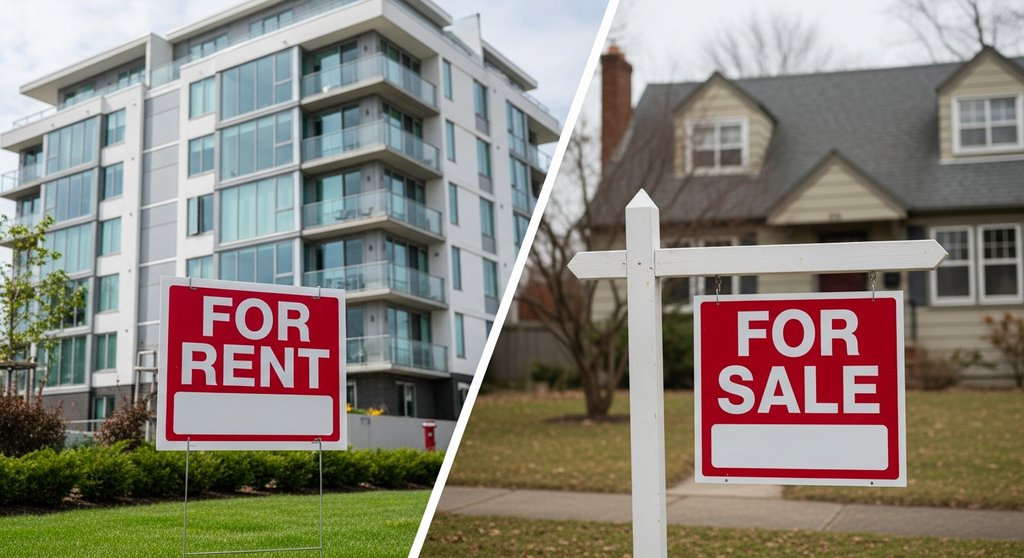
Renting Still Beats Buying in More Cities Than You Think
Owning a home is treated as the obvious win, but the math says otherwise in plenty of US markets. The decision turns on a breakeven point, and in high-price cities that point can sit a decade away. Here is how to run the numbers before you sign anything.
The Price-to-Rent Ratio in One Quick Calculation
The fastest screening tool is the price-to-rent ratio: divide a home's purchase price by the annual rent for a similar place. A $600,000 house next to comparable rentals at $2,500 a month ($30,000 a year) gives a ratio of 20. A common rule of thumb says buying tends to win below 15, the call is mixed from 16 to 20, and renting usually wins above 21.
In expensive metros like San Francisco, Seattle, and parts of greater Los Angeles, ratios routinely top 25 or even 30. At those levels the yearly cost of owning runs well ahead of the rent, and the gap has to be made up by price appreciation that may or may not arrive.
The ratio is a screen, not a final answer, because it ignores mortgage rates and your time horizon. Still, it sorts markets fast. A ratio of 30 means a home costs 30 years of rent up front, which tells you how much price growth the purchase has to deliver just to keep pace with renting and investing the difference.
The Hidden Costs Buyers Forget to Count
A mortgage payment is only part of the bill. Property taxes average roughly 1.1% of value nationally but exceed 2% in states like New Jersey and Illinois. On a $600,000 home that is $6,600 to $12,000 a year before anything breaks. Try the compare the true cost of renting and buying with the rent vs buy calculator to see your own numbers.
Maintenance typically runs 1% to 2% of the home's value annually, so budget $6,000 to $12,000 yearly on that same house. Add homeowners insurance near $1,500 to $3,000, and closing costs of 2% to 5% at purchase. Selling later costs another 6% or so in agent fees, which a renter never pays.
There is one more cost most buyers overlook entirely: the opportunity cost of the down payment. A $120,000 down payment invested at 6% would grow on its own, and that forgone return is a real expense of choosing to buy. Counting it changes the comparison more than any single line on the mortgage statement.
Finding the Breakeven Year
The breakeven is the year owning finally becomes cheaper than renting once every cost is counted, including the down payment you could have invested instead. Below that year, renting and investing the difference comes out ahead.
In moderate markets the breakeven often lands around 4 to 6 years. In high-ratio cities it can stretch to 10 years or more. If you might move before then for a job, a relationship, or a bigger place, the spreadsheet usually favors renting.
The breakeven also moves with assumptions you control. Higher expected home appreciation pulls it closer, while a higher return on invested savings pushes it further out. Run it at a few rates rather than one; if buying only wins under the rosiest appreciation forecast, that fragility is itself a warning.
A Worked Comparison on a $600,000 Home
Buy at $600,000 with 20% down ($120,000) and a 6.5% mortgage on $480,000. The loan payment is about $3,034 a month. Add taxes ($600), insurance ($175), and maintenance ($500), and monthly ownership runs near $4,300 before any tax deductions.
Renting the equivalent home costs $2,500 a month, a $1,800 monthly gap. Invest that gap plus the $120,000 down payment at a 6% return and the renter's portfolio compounds while the buyer waits for appreciation to cover taxes, upkeep, and a future 6% sale commission. Only steady price growth tips this case toward buying.
Put numbers on the appreciation needed. For the buyer to come out ahead in this example within five years, the home would have to climb several percent a year just to offset the down payment's lost investment growth and the costs of buying and selling. In a flat or slow market, the renter who invests the difference simply wins.
When Buying Genuinely Wins
Buying makes clear sense when the price-to-rent ratio is low, you plan to stay seven or more years, and the monthly cost of owning is close to local rent. Lower-cost metros across the Midwest and South often fit this profile, with ratios under 15.
Ownership also locks in housing costs against rising rents and builds equity through forced savings. The point is not that buying is wrong; it is that the choice deserves a real calculation, not a default assumption that renting wastes money.
There are good non-financial reasons to buy as well, from stability for a family to the freedom to renovate. Just price those preferences honestly. Run the breakeven first, then decide how much you are willing to pay above the renting option for the things a spreadsheet cannot measure.