Why Your Loan's Interest Rate and APR Are Not the Same
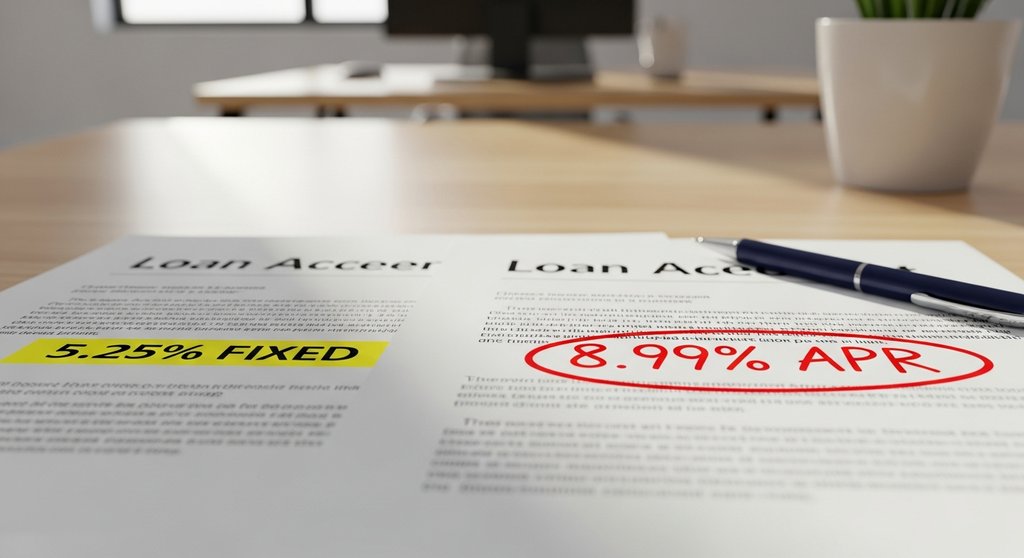
Two loans can advertise the same interest rate and still cost very different amounts. The reason hides in the APR, a broader figure that bakes in the fees the rate ignores. Knowing the gap between them is the difference between comparing loans and being sold one.
The Interest Rate Is Only Part of the Price
The interest rate is the cost of borrowing the principal, expressed as a yearly percentage. On a $20,000 loan at 7%, the rate alone drives the interest portion of each monthly payment. It is the number lenders advertise loudest because it is the most flattering, and it determines the slice of every payment that goes toward interest rather than principal.
What the rate leaves out is everything else you pay to get the loan. Origination fees, points, and certain processing charges all add to your true cost but never show up in the headline rate.
On a mortgage, those add-ons can include discount points, lender fees, and required mortgage insurance. On a personal loan, the big one is usually an origination fee of 1% to 8% of the amount borrowed. Either way, the rate alone tells you what you pay on the balance, not what it cost to get the money.
APR Rolls the Fees Back In
The annual percentage rate, required by the federal Truth in Lending Act, expresses the total cost of borrowing as a single yearly percentage, including most upfront fees. Because it adds those fees on top of the interest, the APR is almost always higher than the stated rate. Try the compare loan offers by their true cost with the loan APR calculator to see your own numbers.
The size of the gap signals how fee-heavy a loan is. A loan with a 7% rate and a 7.1% APR carries minimal fees, while a 7% rate paired with a 8.5% APR is loaded with charges that the rate quietly hides.
By law, lenders must disclose the APR in the same advertisement that quotes a rate, and a loan estimate must show it within three business days of your application. Use that disclosure as a built-in check. If a salesperson talks only about the rate and skips the APR, ask for the number directly.
A Worked Example With Origination Fees
Borrow $20,000 over five years at a 7% interest rate with no fees, and the monthly payment is about $396. Now add a 5% origination fee of $1,000, which the lender deducts so you actually receive $19,000 while still repaying based on $20,000.
You pay 7% interest but only got $19,000 of usable cash, so your effective cost is higher. The APR on that loan works out to roughly 9%, not 7%. The extra two points represent the $1,000 fee spread across the loan's life, which the plain rate completely conceals.
The same fee weighs more heavily on shorter loans, because there are fewer months to absorb it. Roll that $1,000 fee into a one-year loan and the APR jumps far above 9%; stretch it over ten years and the APR barely moves off the rate. Loan length quietly shapes how much a fee actually stings.
Comparing Loans the Right Way
When two offers carry different fees, compare their APRs rather than their rates. A 7.5% rate with no fees can easily beat a 7% rate that hides a hefty origination charge once both are expressed as APR.
Consider a $20,000 loan at 6.9% with $1,500 in fees versus 7.4% with no fees. The first looks cheaper on rate, but its APR climbs near 8.6%, while the second stays at 7.4%. The fee-free loan is the better deal despite the higher advertised rate.
Comparing by APR only works when the loan terms match. Line up the same loan amount and the same repayment length before judging the percentages. A 30-year and a 15-year mortgage can show similar APRs while costing wildly different total interest, so check the term alongside the number.
When APR Can Still Mislead You
APR assumes you keep the loan for its full term. If you plan to refinance or pay off a mortgage in a few years, front-loaded fees weigh more heavily than the APR suggests, because you never recoup them over a shorter period.
APR also handles variable-rate and short-term loans imperfectly, and it can exclude some third-party costs. Use APR as your primary comparison tool, but ask the lender for an itemized fee list so nothing slips past the single percentage.
For an adjustable-rate loan, the quoted APR rests on assumptions about future rates that may not hold, so it understates the cost if rates rise. Treat the figure as a fair comparison for fixed loans and a rough guide for variable ones, and always read the fee breakdown that sits behind it.