Tip, Tax, Discount: Why People Get Percentages Wrong
Percentages show up at every checkout, yet a few predictable errors quietly cost people real money on tips, sales tax, and sale prices.
Percent of versus percent off, the most common mix-up
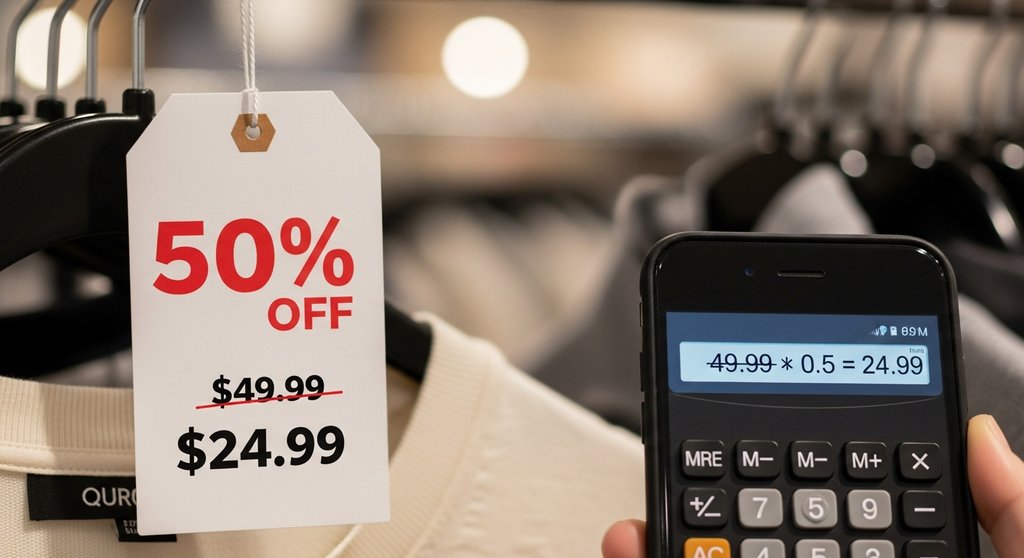
The single biggest error is treating 'percent of' and 'percent off' as the same operation. A 20% tip means you add 20% of the bill, while a 20% discount means you subtract 20% from the price. Same number, opposite direction, and the direction is the part people lose track of.
Take a $50 dinner. A 20% tip is $50 times 0.20, which is $10, so you pay $60. A 20% discount on a $50 jacket is also $10, but you subtract it, so you pay $40. The two results sit $20 apart even though the percentage is identical.
Knowing which way the arrow points keeps a tip from quietly becoming a discount in your head. It also helps when a server's suggested tip is printed as a dollar figure rather than a percent, since you can check whether the math matches the rate you intended.
Why stacking two discounts is not the same as adding them
Stores love to advertise an extra discount on top of a sale, and shoppers love to add the percentages together. A '30% off plus an extra 20%' is not 50% off. The second cut applies to the already reduced price, not the original sticker. Try the free percent calculator to see your own numbers.
On a $100 item, 30% off brings it to $70. The extra 20% comes off that $70, taking $14, so you pay $56. That is a 44% total discount, not 50%, and the $6 gap is exactly what makes the stacked offer look better than it is.
The more discounts you stack, the wider the gap grows between the headline number and what you actually save. A coupon on top of a clearance price on top of a member discount can feel enormous while delivering far less than the sum of the percentages.
Sales tax goes on the discounted price, not the sticker
People often calculate tax on the original price out of habit, which inflates the total. In most states sales tax applies to the amount you actually pay after discounts, so the order of operations matters more than it seems.
Suppose a $200 item is 25% off in a state with 8% sales tax. First take 25% off to get $150. Then add 8% tax on that $150, which is $12, for a final total of $162. Taxing the full $200 first would have you expecting $216, an overestimate of $54 on a single purchase.
Doing the steps in the right order matters whenever discounts and tax both appear. Discount first, then tax on the reduced amount, gives the figure the register will actually print, and it keeps you from overbudgeting for a sale.
Percentage points are not the same as percent
A subtler trap is confusing percentage points with percent change. If a savings rate moves from 4% to 5%, that is a one percentage point rise, but it is a 25% increase in the rate itself. Headlines blur these two ideas constantly.
The distinction changes how you read a deal or a fee. A credit card APR rising from 18% to 20% is two percentage points, yet it is an 11% jump in the interest you owe on a carried balance. The same move sounds trivial or alarming depending on which framing you grab.
Whenever a figure compares two percentages, ask whether the change is measured in points or as a percent of the starting number. That one question keeps a small-sounding shift from hiding a large real cost.
A simple habit that prevents most of these errors
Before doing the math, decide whether you are adding to a number, subtracting from it, or comparing two numbers. That one question sorts tips from discounts and percent from percentage points before you reach for a single digit. It is the step people skip when they are in a hurry at the register.
When several steps stack up, do them in order and write down each result rather than combining them in your head. A discount, then tax, then a tip on the pre-tax amount each lands on a different base, and keeping them separate is what gets you the right total. Combining them in one pass is where the figure goes wrong.
These are ordinary calculations done in the wrong sequence or against the wrong base, not advanced ones. The same discipline pays off beyond the checkout, since interest rates, raises, and tax brackets are all percentages the same three questions sort out. A raise from $60,000 to $63,000 is a 5% bump, and a rate quoted in points hides a larger percent change. Once the habit sticks, the everyday errors mostly disappear.