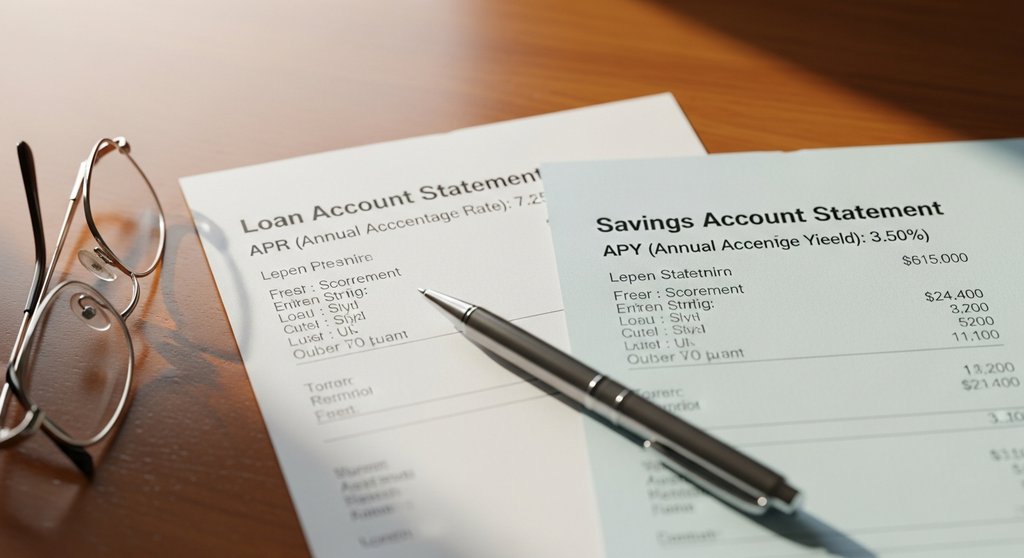
APY vs APR: The Difference That Costs You Real Money
APY and APR look like alphabet soup, but the gap between them decides how much your savings actually grow and how much a loan really costs. One includes compounding and one does not, and lenders pick whichever number flatters their product.
What the Two Acronyms Actually Measure
APR, the annual percentage rate, is a simple yearly rate with no compounding baked in. APY, the annual percentage yield, takes that same rate and accounts for how often interest compounds, monthly, daily, or otherwise.
Because APY folds compounding into one number, it is always equal to or higher than the matching APR. A 5 percent APR compounded monthly works out to about 5.12 percent APY. That small bump is the entire reason the two figures exist as separate terms.
The more often interest compounds, the wider the gap grows. The same 5 percent APR compounded daily climbs to roughly 5.13 percent APY, while annual compounding leaves APY and APR identical. Compounding frequency, not just the headline rate, is the variable that turns one number into the other.
Why Banks Quote APY on Savings
When you are the lender, as you are with a savings account, compounding works in your favor. So banks advertise the APY, the bigger number, because it reflects what you genuinely earn over a year if you leave the money alone. Try the convert a rate into its true annual yield to see your own numbers.
Put $10,000 in an account at 5 percent compounded monthly and you end the year with about $512 in interest, an effective 5.12 percent APY. Quoting the plain 5 percent APR would understate what the saver receives, so the law lets banks show the friendlier figure.
This is why comparing savings accounts is easy as long as everyone quotes APY: it already bakes in compounding, so the higher APY genuinely earns you more. Federal truth-in-savings rules require banks to disclose APY, which is the one consumer-friendly corner of the rate world.
Why Lenders Quote APR on Loans
Flip the roles and the incentive flips too. On a loan, compounding works against you, so lenders prefer to advertise the APR, the smaller number, even though your balance compounds in reality.
A credit card at 24 percent APR does not cost 24 percent if you carry a balance month to month. Compounded daily, that 24 percent APR becomes roughly 27.1 percent APY, the rate you truly pay. The card's marketing will rarely mention that figure.
Mortgages and auto loans behave more predictably because they amortize, but the same principle holds: the stated rate understates what compounding adds when interest is left to accrue. Reading only the APR on revolving debt is how balances grow faster than borrowers expect.
A Worked Example on $10,000
Consider two products with the same headline rate of 24 percent. As a saver earning 24 percent APR compounded daily on $10,000, you would collect about $2,712 in a year, not $2,400. As a borrower owing 24 percent APR on $10,000 carried all year, you would owe that same $2,712, not the $2,400 the APR implies.
The $312 difference is compounding doing its job, helping you in one case and hurting you in the other. The number itself is identical; only the direction changes. That is why comparing one product's APR against another's APY is comparing apples to a slightly bigger apple.
Scale that up and the stakes grow. On a $30,000 balance the same gap is roughly $936 a year, the price of a vacation, vanishing into interest you never saw quoted. The fix is to translate every rate into the same measure before you sign anything.
How to Compare Without Getting Fooled
Always convert both products to the same measure before deciding. For savings, ask for the APY; for loans, convert the APR to its effective yield so you see the real annual cost.
When two offers quote different terms, the safer move is to translate everything into APY. It bakes in compounding frequency, which is the variable most likely to hide the true number. A few seconds of conversion can reveal that the cheaper-looking loan is actually the pricier one.
Keep one rule in mind: whoever benefits from the bigger number will advertise it. Banks show APY because higher looks better to a saver, and lenders show APR because lower looks better to a borrower. Knowing the bias tells you which number you are missing and which one to calculate yourself.
One last tip for borrowers: the way to dodge the APY penalty on a credit card is simply to avoid carrying a balance. Pay the statement in full each month and the compounding never starts, which turns a punishing 27 percent effective rate into zero interest paid. The acronym only matters once a balance lingers.