Should You Tip on the Pre-Tax or the Post-Tax Total?
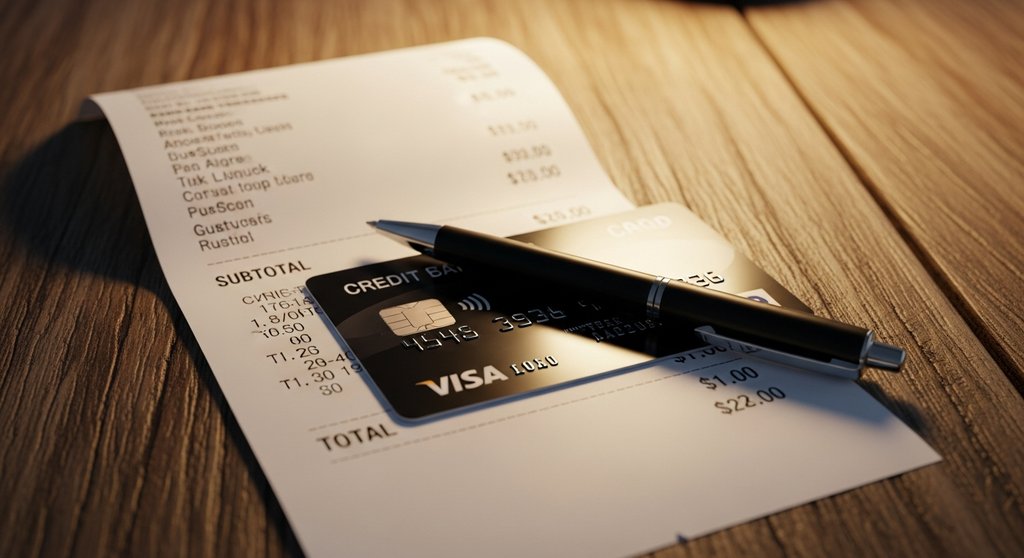
The receipt arrives with two numbers staring back: the food total and the bigger total after sales tax. Tip on which one? The honest answer is that it barely changes your bill, but the etiquette and the math are worth knowing before you sign.
What Etiquette Experts Actually Say
The traditional rule is to tip on the pre-tax subtotal, since the tax goes to the state and the server had nothing to do with it. Tipping on the food and drink alone rewards the service, not the government.
In practice, most Americans tip on whatever total the receipt shows, which is the post-tax number. Neither choice is wrong, and no server will think less of you for either. The pre-tax approach is technically the purist's method; the post-tax approach is simply easier.
Many printed receipts make the choice for you by listing suggested tip amounts calculated on the post-tax total. Those suggestions are a convenience, not a rule, and you are free to base your tip on whichever line you prefer.
Worth knowing: in most states, sales tax does not apply to the tip itself, so you are never taxed on what you leave the server. The only question is whether you calculate your percentage before or after the tax that applies to the food, and that choice is yours alone to make.
Current US Tipping Norms
For sit-down restaurant service, the common range is 18 to 20 percent, with 20 percent now treated as the default for good service in many cities. Below 15 percent signals a real problem with the meal. Try the split the check and figure the right tip to see your own numbers.
Counter service, takeout, and coffee shops sit lower, often 10 percent or a flat dollar or two, and many people tip nothing on pure takeout. The pre-tax-or-post-tax question only matters at full-service spots where the percentage is large enough to notice.
Tipping norms have crept upward over the past decade, partly because card readers now prompt for 20, 25, or 30 percent at the register. Those prompts shape expectations, but they are not law, and a thoughtful 18 to 20 percent at a restaurant remains perfectly respectable.
A Worked Example on an $80 Bill
Take an $80 food subtotal in a state with 8 percent sales tax, making the post-tax total $86.40. Tip 20 percent on the pre-tax $80 and you leave $16. Tip 20 percent on the post-tax $86.40 and you leave $17.28.
The difference is $1.28. You are essentially tipping 20 percent on the $6.40 of tax, which adds $1.28 to the server's take. Over a single dinner that is a rounding error, the cost of a soda refill.
Push the tax rate higher and the gap widens only a little. In a 10 percent tax city, the same $80 meal yields a post-tax tip of $17.60 versus $16 pre-tax, a difference of $1.60. The decision still moves your total by less than the price of a coffee.
When the Difference Adds Up
On one meal, $1.28 is nothing. Across a year of dining out, the picture shifts. If you eat at full-service restaurants twice a week and the average tax-on-tip gap is around $1.30, post-tax tipping costs you roughly $135 more annually.
That is real money if you are budgeting tightly, and it is also a small, painless way to tip a little more generously if your finances allow. Knowing the figure lets you choose on purpose instead of by accident.
The same logic scales with how often you dine out. A frequent diner who eats out four times a week could see the annual gap approach $270, while someone who reserves restaurants for special occasions will never notice it. Match the choice to your own habits.
A Simple Rule for the Table
If you want to be precise and slightly thrifty, tip on the pre-tax subtotal. If you want speed and a touch more generosity, tip on the post-tax total and do not think twice.
Either way, round to a whole dollar so the math is easy and the server gets a clean number. The choice that actually matters for service quality is the percentage you pick, not which line of the receipt you start from.
A fast mental shortcut helps at the table: take 10 percent of the pre-tax subtotal by moving the decimal one place, then double it for a clean 20 percent. On an $80 meal that is $8 doubled to $16, no app required.
If you ever feel torn, remember that the server would rather you tip a fair percentage on either total than agonize over the tax line. A generous percentage on the pre-tax amount almost always beats a stingy percentage on the post-tax amount, so spend your attention on the rate, not the receipt line.