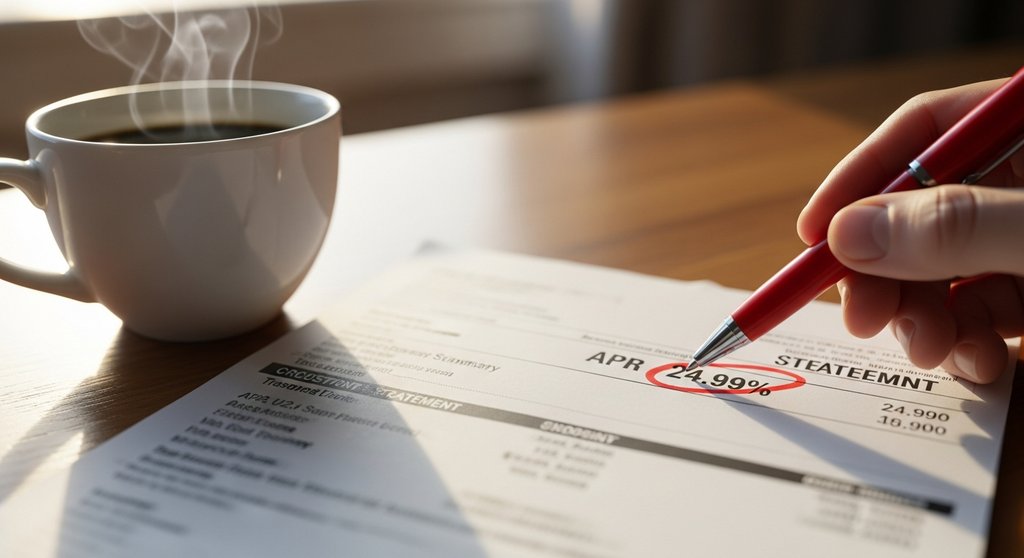
Why Your 24% APR Credit Card Costs More Than You Think
Most cardholders think their APR is a once-a-year charge, but credit card interest compounds daily, and that gap between perception and reality costs Americans billions each year.
APR Is Annual in Name Only
When a card advertises a 24% APR, most people mentally divide that by 12 and figure they owe 2% per month if they carry a balance. That math is close but wrong in a way that adds up fast. Card issuers convert your APR into a daily periodic rate by dividing it by 365, so 24% becomes roughly 0.0658% per day.
That daily rate then compounds against your balance every single day of the billing cycle, not once at the end of the month. On a $3,000 balance, a flat 2% monthly calculation would suggest $60 in interest. The daily compounding method produces closer to $60.50 to $61, depending on cycle length. Small difference on one bill, but multiplied across 12 months it adds roughly $6 to $8 you never planned for.
The Real Damage Happens When You Pay the Minimum
Minimum payments are designed to keep you in debt, not to get you out of it. A typical minimum is 1% of the balance plus interest, or about $25 to $35 on a $3,000 balance. At 24% APR, roughly $59 of interest accrues that month, so a $75 minimum payment shaves only $16 off your principal. Try the credit card interest and payoff calculator to see your own numbers.
Run that trajectory forward and a $3,000 balance at 24% APR with minimum-only payments takes over 14 years to clear and costs nearly $4,600 in interest. That is more than 150% of the original balance paid purely to the lender. Plugging your own numbers into a credit card APR calculator shows you exactly where the payoff date lands and how much extra cash is quietly leaving your pocket.
Why Today's Rate Environment Makes This Worse
The Federal Reserve's rate hikes between 2022 and 2024 pushed average credit card APRs from around 16% to well above 21%, with many cards now sitting at 27% to 29%. Unlike mortgage rates, card rates are variable and tracked the Fed funds rate almost immediately on the way up. The Fed has begun cutting rates, but card APRs have been slow to follow, a pattern that repeats every easing cycle.
That lag matters if you are carrying a balance and waiting for relief. A card at 27% APR on a $5,000 balance costs about $112 per month in interest alone. At 21% the same balance costs roughly $87. Waiting six months to refinance or pay down while rates drift down slowly is still a $150 to $200 mistake. The faster move is to attack the balance now, or shift it to a 0% promotional card, rather than betting on quick rate relief.
How to Use the Numbers to Build a Payoff Plan
Start by gathering your current balance, your exact APR from the back of your statement, and your expected monthly payment. Even a $25 bump above the minimum can slash months off your payoff timeline. On a $3,000 balance at 24% APR, raising a $75 minimum to $100 cuts payoff time from roughly 14 years to about 4 years and saves more than $3,000 in interest.
A credit card interest and payoff calculator does this arithmetic in seconds and lets you test different payment amounts side by side. Try entering three scenarios: current minimum, minimum plus $25, and minimum plus $50. The gap between those columns is usually enough to motivate an immediate change.