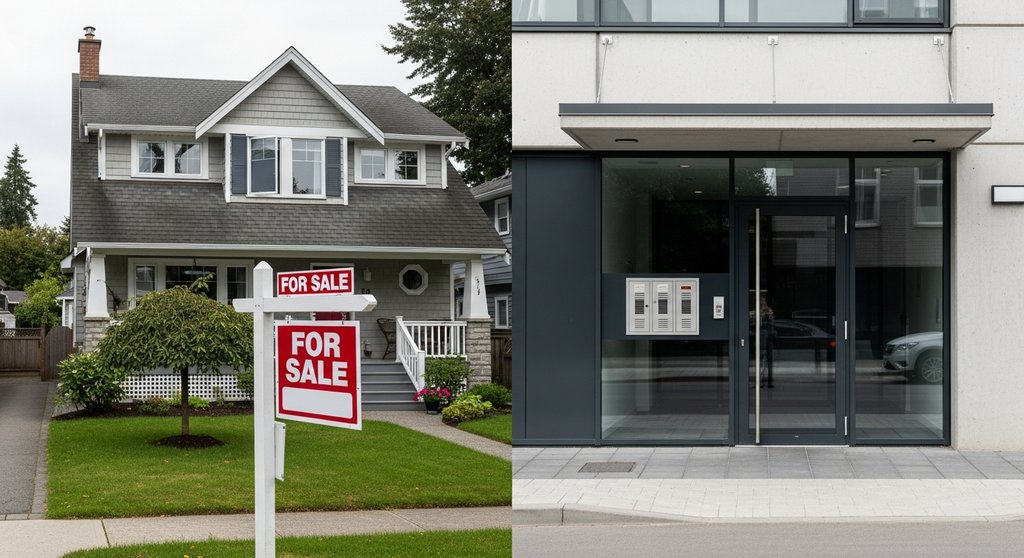
Renting Beats Buying in More Cities Than You Think
Most people assume buying is always the smarter long-term move, but at current mortgage rates, the math says otherwise in a surprising number of markets.
Why the 'Buy Always Wins' Rule Broke Down
For decades, the conventional wisdom held that renting was throwing money away. That logic made sense when 30-year fixed rates sat below 4% and home prices were modest relative to local rents. Neither of those conditions is true right now.
With rates hovering around 6.5% to 7%, a $400,000 home purchase comes with roughly $2,650 a month in principal and interest alone, before property taxes, insurance, and maintenance. In many metro areas, a comparable rental runs $1,800 to $2,200. That gap is real money, and it compounds when you factor in the opportunity cost of a $80,000 down payment sitting in a house rather than an index fund.
The Five-Year Assumption That Trips People Up
A persistent misconception is that buying pays off after five years, almost universally. That figure comes from an era of low rates and steady 4% to 6% annual appreciation. Today, in flat or softening markets, five years may not be long enough to recoup closing costs, which typically run 2% to 5% of the purchase price on the way in, plus 5% to 6% in agent commissions on the way out. Try the rent vs buy comparison calculator to see your own numbers.
Run a quick example: buy a $350,000 home, put 10% down, and pay 6.75% on the loan. After five years of 3% annual appreciation, your home is worth about $405,000. Subtract a $24,000 sales commission, $10,500 in closing costs at purchase, and roughly $42,000 in interest paid over five years. You come out ahead, but only barely, and only if appreciation holds. Shift appreciation to 1% per year and the picture reverses.
This is exactly the kind of scenario where a dedicated rent vs buy comparison calculator earns its keep. Plugging in your actual local rent, expected home price, down payment, and rate gives you a breakeven timeline that is specific to your situation, not a national average.
What the Calculator Actually Measures That Mental Math Misses
Most people do back-of-the-envelope math that compares a mortgage payment to a rent check. That misses several large line items on the ownership side: property taxes averaging 1% to 1.5% of home value annually, homeowner's insurance, HOA fees where applicable, and maintenance, which financial planners typically budget at 1% of home value per year. On a $400,000 home, that maintenance line alone is $4,000 a year, or $333 a month.
On the renting side, the calculation often ignores what you could do with the down payment. $60,000 invested in a broad market index fund at a historical 7% real return grows to about $84,000 in five years. That is wealth accumulation happening outside the house, and it matters.
A good rent vs buy comparison tool models both paths simultaneously, applying the same time horizon to your invested down payment as to your home equity. That parallel view is the only honest way to compare the two choices.
Three Inputs That Change the Answer Most
Annual home price appreciation is the single biggest lever. At 4% yearly growth, buying almost always wins over a ten-year horizon. At 1% to 2%, renting is competitive or better in high-cost markets. Check recent sales data for your specific zip code rather than relying on national headlines.
How long you plan to stay is the second lever. Under three years, buying rarely pencils out after transaction costs. Beyond seven years, ownership advantages tend to compound in most markets. If your job situation is uncertain or you value flexibility, shorter horizons favor renting even in appreciating markets.
The third factor is your rent growth rate. If your landlord raises rent 5% a year, the locked-in mortgage payment looks more attractive over time. If you have a rent-stabilized apartment or a landlord unlikely to raise rates aggressively, the renting path becomes far more durable financially.