Why Your 20% Discount Is Rarely 20% Off the Final Price
That 20% off sticker looks straightforward until you factor in sales tax, service fees, and the fine print that quietly shrinks your savings.
The Tax-Added Trap That Inflates Your Final Bill
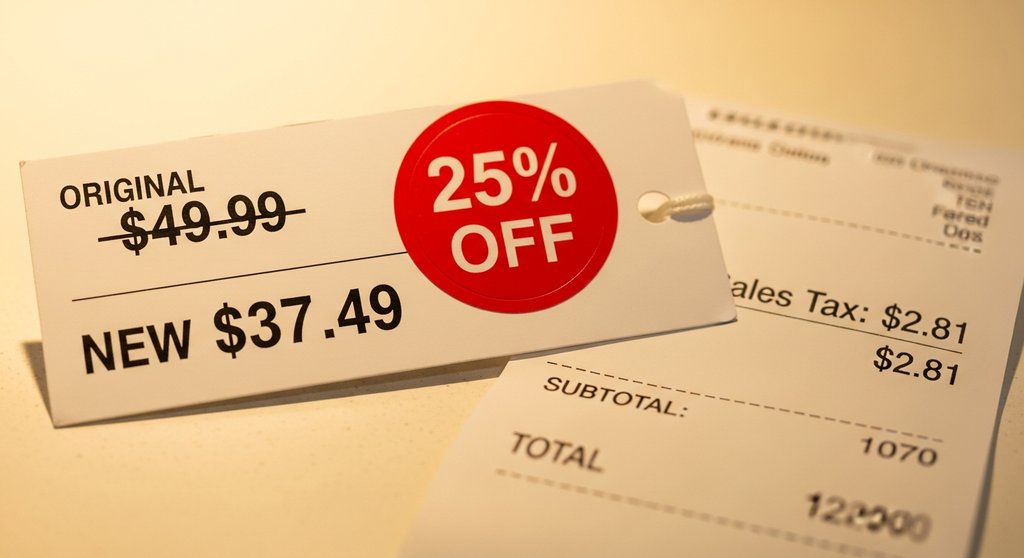
A $120 jacket marked 25% off drops to $90 before tax. In a city with a 9% sales tax, you pay $98.10 at the register. The discount saved you $30, but tax added back $8.10, so your real savings off the original taxed price is closer to 18%, not 25%. Retailers advertise pre-tax discounts because they are allowed to, not because it is the most useful number for your wallet.
This gap widens the more expensive the item. On a $1,200 laptop with 20% off, the pre-tax saving is $240. At 10% sales tax, the final bill is $1,056. If you had paid full price plus tax, that would have been $1,320, so the true saving is $264 including tax relief. The percentage off the total transaction ends up at exactly 20% in that case, but only because tax scales proportionally. The moment you add a flat service fee or a non-discountable shipping charge, the real percentage falls below the advertised figure.
How Stacked Coupons Create Misleading Total Savings Claims
Stores sometimes advertise 'up to 40% off' when the path to that figure requires stacking a 20% sale price with a 20% member coupon. The catch is that the second 20% applies to the already-reduced price, not the original. Start at $100, take 20% off to reach $80, then take 20% of $80 to reach $64. Total saving is $36, which is only 36%, not 40%. That four-point gap feels small until you are comparing it across a $2,000 appliance purchase, where it translates to $80 of missing savings. Try the percent calculator to see your own numbers.
Loyalty programs compound this confusion by expressing rewards as 'percentage back' while burying minimum spend thresholds or per-category caps. A 5% cashback card that caps at $1,500 in grocery spend per quarter delivers a maximum of $75 back, which on a $6,000 annual grocery spend is actually 1.25%, not 5%. Checking the actual numbers before committing to any stacked deal takes less than a minute with a percentage calculator, and it frequently changes which option wins.
Percentage Increases Hurt More Than Equivalent Decreases Help
A price rising 50% and then falling 50% does not return to the original number. Start at $200, add 50%, and you are at $300. Drop that by 50%, and you land at $150. You are out $50 from your starting point despite the symmetrical-sounding percentages. This asymmetry catches people off guard in investing, salary negotiations, and subscription pricing alike.
Grocery prices illustrate this constantly. A staple item that rose 30% during a supply squeeze and then 'came down 15%' is still 10.5% more expensive than before the original increase. Shoppers who remember the pre-rise price often feel cheated by a sale that looks generous on a percentage tag but does not restore value. Running the actual numbers through a reliable percent calculator takes seconds and immediately shows you where you stand.
A Quick Framework for Sanity-Checking Any Percentage Claim
Before accepting a discount, tip percentage, or percentage-based fee at face value, ground it in an actual dollar amount. A 3% credit card processing fee on a $4,500 home repair quote is $135 extra. A 1.5% property tax rate on a $380,000 home is $5,700 annually. Stating the number in dollars rather than percentages makes the cost feel real and lets you compare it to alternatives directly.
The cleanest habit is to verify at least one percentage per purchase that carries material cost. That does not mean obsessing over every transaction; it means that on anything above $50, spending 20 seconds confirming the math protects you from a class of errors that most people never catch. A good percentage tool handles the arithmetic so you can focus on the decision itself.