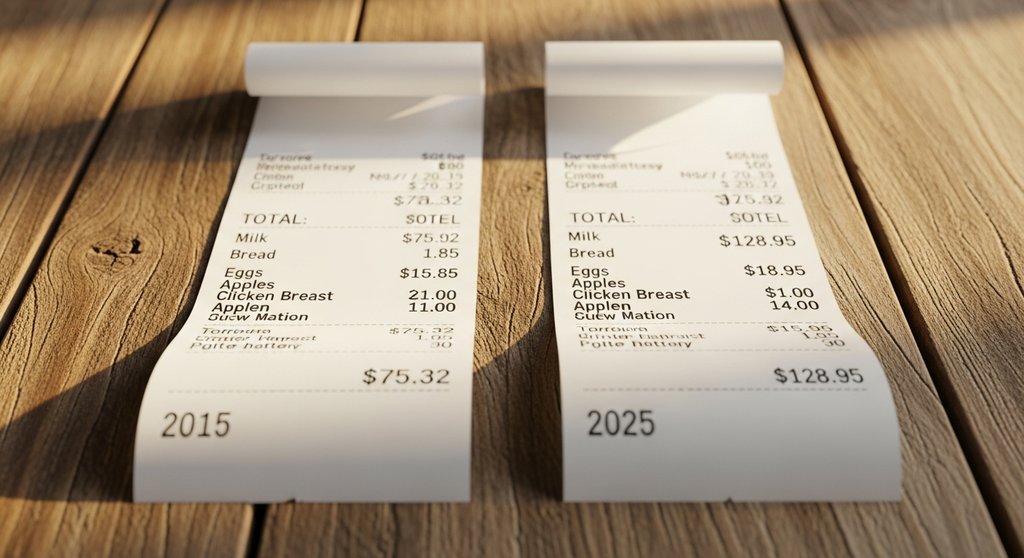
Why Your 2015 Salary Feels Smaller in 2025
Getting a raise every few years feels like progress, but inflation has a habit of quietly canceling out the celebration.
The Raise That Wasn't Really a Raise
Say you earned $60,000 in 2015 and now earn $72,000 in 2025. That looks like a 20% increase on paper. The problem is cumulative U.S. inflation between 2015 and 2025 has run close to 35%, meaning your purchasing power has actually fallen in real terms. You are earning more dollars, but each dollar buys noticeably less groceries, gas, and rent.
This is the trap a lot of workers fall into during annual review conversations. Employers often frame a 3% raise as generous, but if inflation is running at 4%, that raise is a pay cut in everything but name. Knowing the actual inflation-adjusted figure gives you a concrete number to bring to the table.
How Compounding Inflation Adds Up Faster Than People Expect
Most people think of inflation as a small annual nuisance, around 2 to 3 percent, nothing dramatic. But inflation compounds just like interest does. A steady 3% annual rate over 10 years does not erode purchasing power by 30%. It erodes it by about 26%, and a 4% rate over a decade hits closer to 32%. Add the post-2021 inflation surge into the mix and the real losses over five to ten years are steeper than most workers realize. Try the inflation adjusted value calculator to see your own numbers.
The compounding effect means the longer you hold a fixed income, a fixed rent payment from a tenant, or a fixed-rate bond, the more dramatically the real value drifts from the nominal value. That $1,200 monthly rent you locked in for a commercial tenant in 2018 is worth roughly $960 in 2018 dollars by 2025.
Practical Scenarios Where This Calculation Actually Matters
Salary negotiation is the obvious one, but inflation adjustment shows up in a lot of places people overlook. Freelancers who set their day rates years ago and never revised them are effectively offering annual discounts. Retirees living off fixed pension payments are watching their real income shrink every single year. Even parents comparing the cost of college in the 1990s to today need an inflation-adjusted lens to have an honest conversation.
Estate planning is another area where this matters. An inheritance of $200,000 left in a will written in 2005 has very different real-world weight in 2025 than the testator intended. Running the numbers through an inflation adjusted value calculator helps beneficiaries and planners understand what that sum represents in today's purchasing power before making decisions about how to use it.
Business owners reviewing long-term contracts, landlords setting lease renewal terms, and nonprofit boards evaluating historical donation data all face the same underlying problem: nominal figures hide the real story. Adjusting for inflation is not an academic exercise. It is the only way to compare dollar amounts across different time periods honestly.
What to Do Once You Know Your Real Number
Once you have the inflation-adjusted figure, the next step is deciding what to do with it. For salary negotiations, the gap between your 2015 real earnings and your 2025 earnings gives you a specific, defensible number rather than a vague feeling that you are underpaid. Saying 'my inflation-adjusted purchasing power has dropped by $8,400 since 2015' lands differently than saying 'I feel like I deserve more'.
For savers and investors, the exercise is a useful reminder that cash sitting in a low-yield account is losing real value every year. If your savings account paid 0.5% annually during a period when inflation averaged 4%, you lost ground every single month even as your balance grew. Understanding that gap is often the nudge people need to move money into assets that have historically outpaced inflation over long periods.