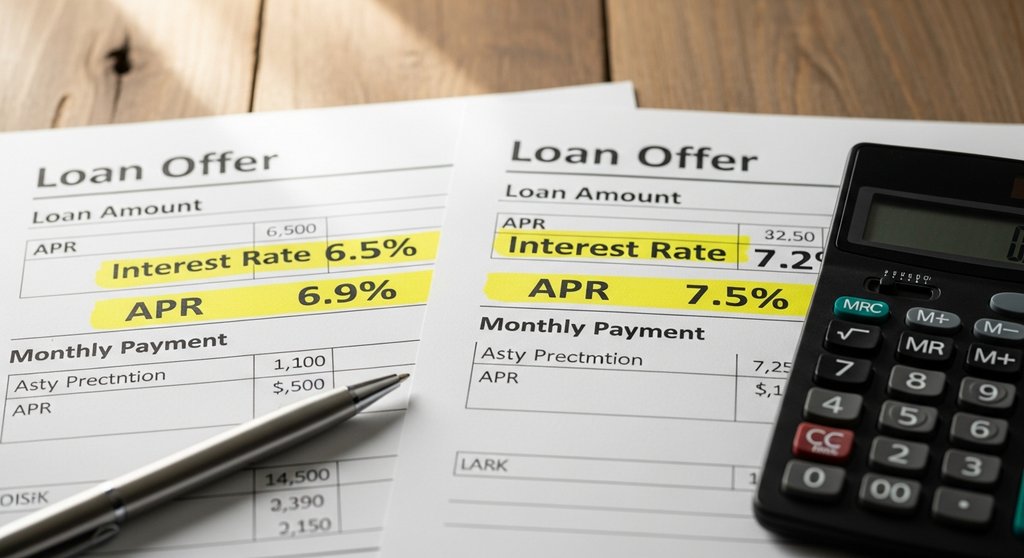
Why Your Loan's Interest Rate and APR Are Not the Same
A lender can advertise a 6.5% interest rate while the loan actually costs you closer to 8% once fees are folded in, and most borrowers never catch the difference until it's too late.
The Fee That Hides Inside Your Interest Rate
The interest rate on a loan tells you one thing: what percentage of the principal you pay annually in interest charges. That's it. It says nothing about origination fees, broker fees, mortgage insurance, or discount points. The APR, by contrast, rolls all of those costs into a single annual percentage so you can see the true price of borrowing.
Here's a concrete example. Say you take a $20,000 personal loan at a stated 7% interest rate over 48 months. If the lender also charges a 2% origination fee ($400), your APR jumps to roughly 8.1%. That gap costs you hundreds of dollars that a quick rate comparison would never reveal.
What a 1% APR Difference Actually Does to Your Monthly Payment
People often treat a 1% gap as a rounding error. It is not. On a $30,000 auto loan over 60 months, the difference between a 6% APR and a 7% APR adds up to about $16 per month, which sounds manageable. But over five years that's nearly $960 in extra payments, plus you can run that same amount through an index fund and see what compounding does to it. Try the loan APR calculator to see your own numbers.
The math gets sharper on longer loans. A 30-year mortgage of $350,000 at 7% APR versus 6% APR produces a monthly payment difference of roughly $233. Across the life of the loan that single percentage point costs over $83,000. This is why comparing APRs, not teaser rates, is the only sensible way to shop.
A loan APR calculator makes these comparisons fast. Plug in the principal, the stated rate, the term, and any upfront fees, and you get the true APR in seconds, no spreadsheet required.
When a Lower APR Can Still Be the Wrong Choice
There is one situation where a higher APR loan sometimes wins: when you plan to pay off the debt early. APR calculations assume you hold the loan for its full term. If a lender buries high upfront fees into a low-rate product, those fees are sunk costs. If you pay the loan off in year two of a five-year term, your effective cost of borrowing is higher than the APR label suggests because you paid the fees but didn't spread them over as many months.
Conversely, a loan with zero fees but a slightly higher rate gets cheaper the faster you repay it, because the interest cost shrinks with the balance while the fee cost stays at zero. Always ask yourself how long you realistically expect to hold the debt before picking the lowest APR option off a comparison sheet.
How to Use APR to Compare Offers Side by Side
Get at least three loan offers in writing. Under federal Truth in Lending Act rules, every lender must disclose the APR in their loan estimate documents, so you are entitled to see it before signing anything. Line up the APRs, not the interest rates, not the monthly payments in isolation.
Monthly payment comparisons mislead because a lender can make any loan look affordable by stretching the term. A 72-month auto loan at 9% APR has a lower payment than a 48-month loan at 6% APR, but the total interest paid is dramatically higher. Use a loan APR calculator to model both scenarios and compare total cost, not just the monthly bite.
Once you have the numbers, negotiate. Lenders often waive or reduce origination fees for qualified borrowers, especially in a competitive rate environment. Even shaving 0.5% off your APR on a five-year loan can save enough to cover a car insurance payment for a year.