Why Your Loan Balance Barely Drops in Year One
You have made 12 on-time payments and your loan balance has barely moved, and that is not a glitch.
The Front-Loading Problem Nobody Warns You About
When a lender amortizes a loan, every payment you make is split between interest and principal. In the early months, the split is brutally skewed toward interest. On a 30-year, $300,000 mortgage at 7%, your first payment of roughly $1,996 sends about $1,750 to interest and only $246 to actually reducing what you owe. After a full year, you have paid nearly $24,000 and reduced your balance by less than $3,000.
This is not predatory math. It is how simple interest on a declining balance works. You owe the most money on day one, so the lender charges the most interest on day one. The problem is that most people picture their payments chipping away evenly at the debt, which leads to a real shock when they check their statement after year one.
What the Amortization Schedule Actually Tells You
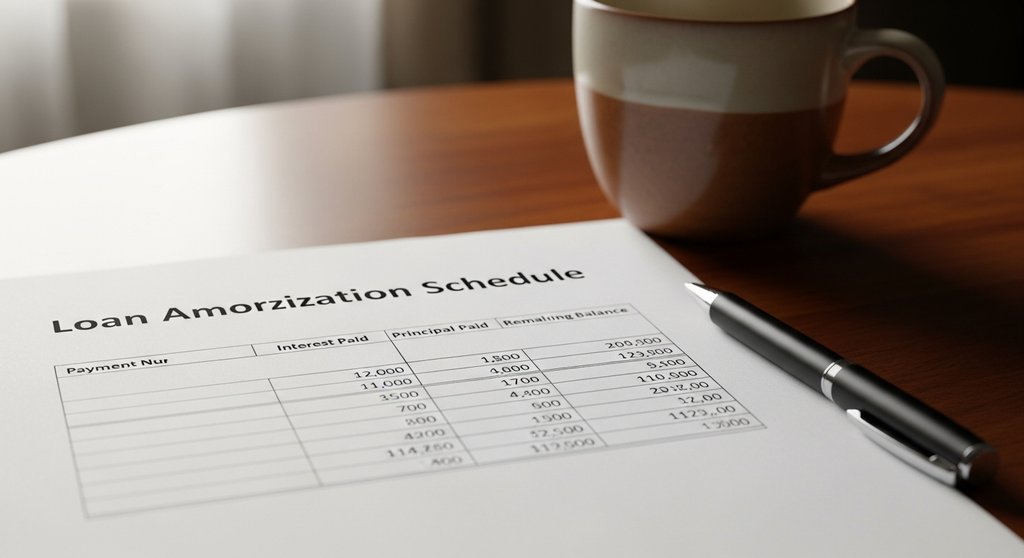
An amortization schedule is a month-by-month table showing exactly how each payment is divided. Pull one up for any loan and you will see the crossover point, the specific month when your principal payment finally exceeds your interest payment. On that same $300,000 loan at 7%, that crossover does not happen until around month 252, which is year 21. Try the loan amortization calculator to see your own numbers.
That single fact changes how smart borrowers think about extra payments. Paying one extra $246 principal payment in month one achieves the same debt reduction as the principal portion of month two's payment, but it also eliminates the interest charge attached to month two. Every extra dollar you send early erases a disproportionate amount of total interest over the life of the loan.
Seeing the full schedule in writing is the fastest way to understand this. A loan amortization calculator lets you run the numbers for your exact balance, rate, and term in about 30 seconds, and most good ones will also show you a revised schedule if you add a monthly extra-payment amount.
Running a Real Scenario with Extra Payments
Take a $25,000 auto loan at 8.5% over 60 months. Your regular payment is about $513 per month. Over five years you will pay roughly $5,780 in total interest. Add just $100 per month to each payment and you pay the loan off in 49 months instead of 60, saving around $1,400 in interest and clearing the debt nearly a year early.
That $100 example is not dramatic, but scaled to a mortgage it becomes life-changing. On that same $300,000 at 7%, adding $200 per month shaves about four years off the loan and saves roughly $67,000 in interest. The earlier you start, the bigger the effect, because you are cutting principal during the period when the interest charges are at their highest.
When Refinancing Math Gets Tricky
If you are considering a refinance in a still-elevated rate environment, the amortization schedule reveals a hidden cost most articles skip. When you refinance, you typically restart the amortization clock. Even if your new rate is slightly lower, you may be moving from year 10 of a 30-year loan back to year one of a new 30-year loan. That means returning to the high-interest, low-principal phase all over again.
The only way to evaluate this properly is to compare total interest paid under both scenarios, not just the monthly payment. A lower monthly payment can actually cost you far more over time if it extends your front-loaded interest period. Run both loan terms through a full schedule before you sign anything.