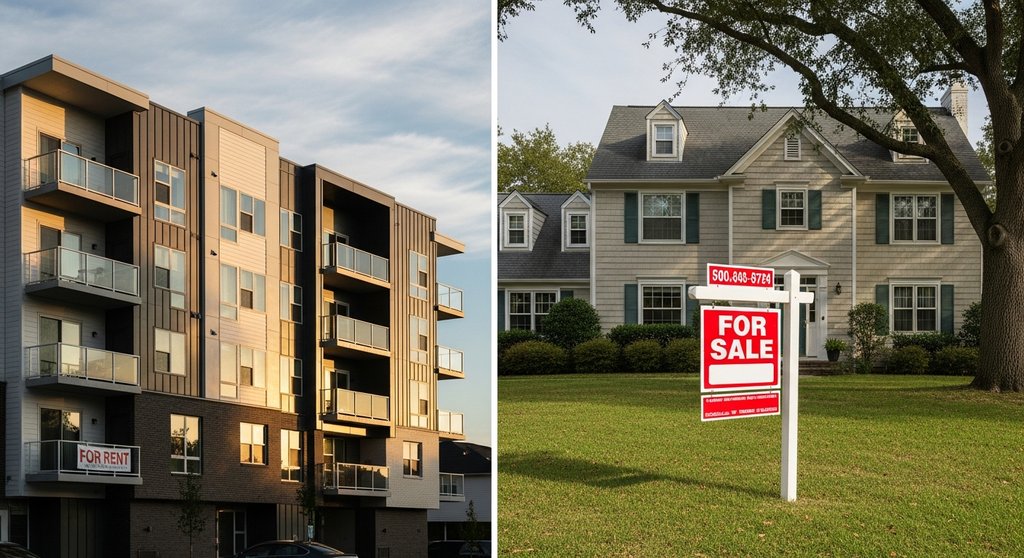
Renting Is Throwing Money Away? Not So Fast
The idea that rent payments are wasted money is one of the most stubborn myths in personal finance, and it quietly pushes people into buying homes before the math actually works in their favor.
Why 'Building Equity' Is Not the Whole Story
When you buy a home, a big slice of each early mortgage payment goes to interest, not equity. On a $400,000 mortgage at 7% APR, roughly $2,333 of your first $2,661 monthly payment is pure interest. That is money gone, just like rent, except you also own the maintenance bills.
Owners also pay property taxes, homeowner's insurance, HOA fees, and repairs that renters never see. A reasonable estimate for ongoing ownership costs runs between 1% and 2% of the home's value per year. On a $400,000 house, that is $4,000 to $8,000 annually before you touch the mortgage.
The Break-Even Timeline Most Buyers Underestimate
Buying a home costs a significant amount upfront: closing costs alone typically run 2% to 5% of the purchase price. On that same $400,000 home, you might spend $12,000 to $20,000 just to get the keys. If you sell within a few years, those costs rarely get absorbed by price appreciation. Try the rent vs. buy comparison tool to see your own numbers.
Real estate research consistently shows that break-even timelines, the point where buying becomes cheaper than renting the same property, range from four to seven years in most U.S. markets. In high-cost cities like San Francisco or New York, that horizon can stretch past a decade. Moving before you hit break-even means renting was the smarter financial choice, full stop.
That timeline shifts dramatically depending on your local rent-to-price ratio, expected appreciation, your mortgage rate, and what you do with the money you would have spent on a down payment. Plugging those numbers into a rent vs. buy calculator gives you a personalized break-even point rather than a guess.
What Higher Interest Rates Actually Changed in 2024 and 2025
The rate environment of the past two years reshuffled the math considerably. When 30-year mortgage rates hovered near 3% in 2021, buying looked attractive in almost every scenario. With rates above 6.5% through much of 2024, the monthly carrying cost of ownership jumped by hundreds of dollars compared to renting the equivalent home.
A family considering a $450,000 home at 7% faces a principal-and-interest payment of about $2,994 per month. If comparable homes rent for $2,200 in the same neighborhood, the buyer is paying nearly $800 more each month before taxes, insurance, or repairs. That gap has to be recovered through appreciation and tax benefits over several years just to break even with the renter who invested the down payment difference.
Running the Numbers Before You Decide
The honest answer to rent versus buy is almost always 'it depends,' but not in a vague hand-waving way. It depends on specific inputs: your target home price, local rent prices, how long you plan to stay, your marginal tax rate, and a realistic appreciation assumption for your market.
Conservative appreciation in most markets over the long run averages around 3% to 4% annually, close to inflation. Assuming 6% or 7% because prices surged recently is a common mistake that skews the analysis heavily toward buying. Using a rent vs. buy comparison tool with realistic numbers, especially one that factors in opportunity cost on your down payment, will show you whether ownership pencils out in your specific situation rather than in the abstract.
No formula replaces judgment about your life plans, job stability, and how much you value flexibility. But the math should come first. If the numbers say break even happens in year eight and you are not sure you will stay five years, that is a signal worth respecting before signing a 30-year note.