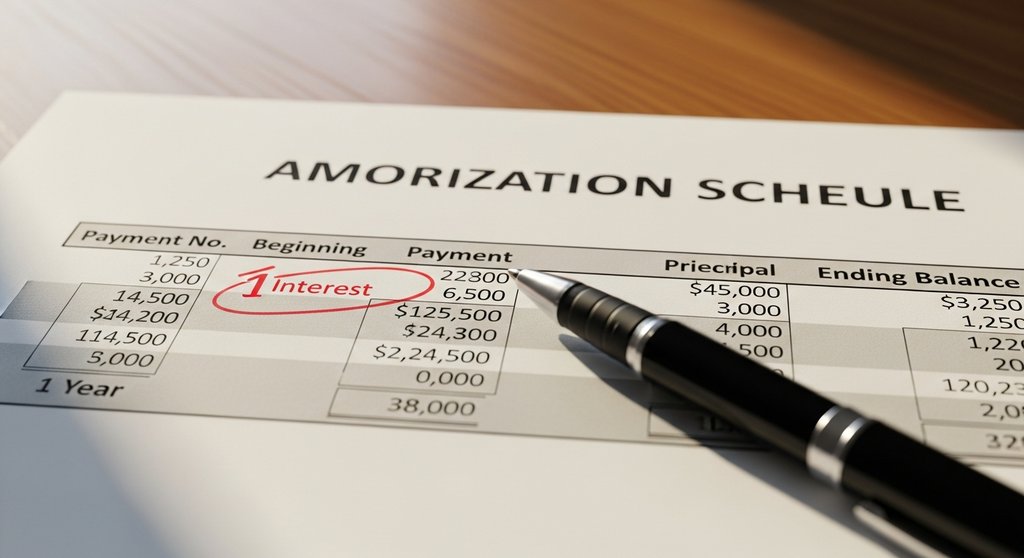
Why Your Loan Balance Barely Drops in Year One
You've been paying your loan for 12 months and the balance looks almost identical to what you borrowed, and that's not a glitch.
The Front-Loading Effect Most Borrowers Miss
Every fixed-rate loan uses a structure called amortization, where each monthly payment covers interest first and principal second. In the early months, the interest portion can eat up 80 to 90 percent of your payment. The principal barely moves.
Take a $25,000 personal loan at 9% APR over 5 years. Your monthly payment is about $519. In month one, roughly $188 goes to interest and only $331 chips away at the balance. By month 60, that flips completely, with most of the payment reducing principal. The bank collects the bulk of its profit right up front.
What $1 Extra Per Month Actually Does Over 5 Years
Because interest compounds on the remaining balance, any extra payment you make early has an outsized effect. Paying an extra $50 per month on that same $25,000 loan cuts roughly 6 months off the repayment schedule and saves around $400 in total interest. Timing matters: the same $50 extra in year four saves far less. Try the loan amortization calculator to see your own numbers.
This is why financial advisors consistently recommend making extra principal payments as early as possible, not as a lump sum near the end of the loan. Run the numbers yourself with a loan amortization calculator to see exactly which month your extra payments start showing up as real balance reductions.
How a Falling Rate Environment Changes the Calculus
With interest rates having climbed sharply over the past few years and now showing signs of softening, many borrowers are weighing whether to refinance. The break-even analysis is less obvious than it looks. If you refinance after year two of a 5-year loan, you restart the amortization clock and go back to paying mostly interest again, even if the new rate is lower.
The total interest saved from a lower rate can easily be wiped out if you extend the loan term at the same time. A borrower refinancing a $20,000 auto loan from 8% to 6% but stretching the term from 3 years remaining to 5 years will pay more in total interest, not less. Always compare total cost, not just monthly payment.
A good rule of thumb: refinancing makes sense if you can lower your rate by at least 1.5 percentage points and keep the remaining term the same or shorter. Otherwise, the math usually works against you.
Reading an Amortization Schedule Like a Pro
An amortization schedule is a month-by-month table showing exactly how each payment splits between interest and principal. Most borrowers never look at one. That's a mistake, because it reveals the precise month where your equity or ownership stake crosses 50%, which matters for insurance, refinancing, and selling decisions.
For a home purchase, crossing the 20% equity threshold eliminates private mortgage insurance, which can save $100 to $200 per month. Knowing the exact month that happens lets you request the cancellation proactively rather than waiting for the lender to act. The schedule also shows how a single extra payment in month 6 ripples through every subsequent row.