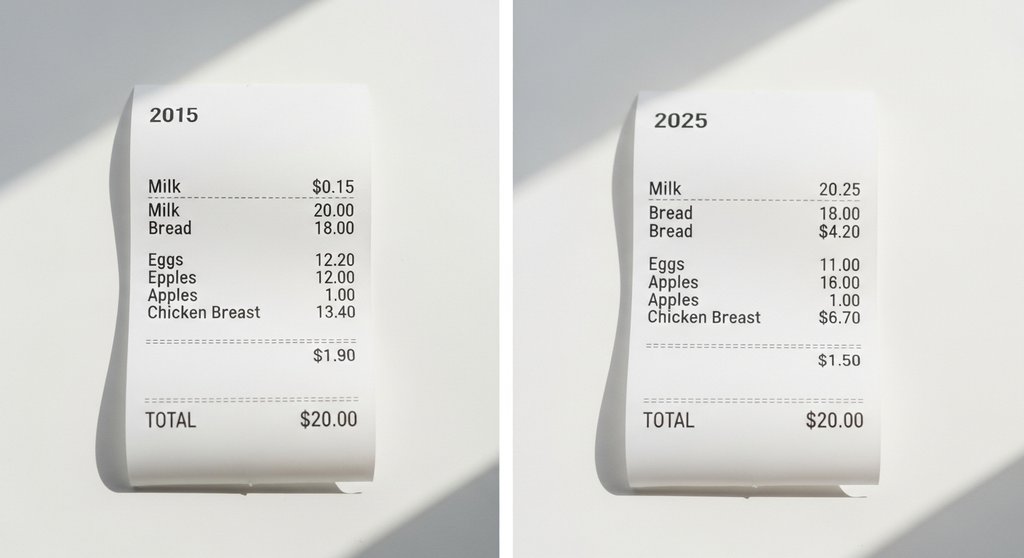
Your 2015 Salary in 2025 Dollars: What It Really Buys
A raise that looks generous on paper can quietly leave you poorer if inflation ran faster than your paycheck did.
Why Most People Get Their Raise Math Wrong
Ask someone if they earn more than they did a decade ago, and nearly everyone says yes. Ask if they earn more in real terms, and the conversation gets uncomfortable. Between January 2015 and January 2025, cumulative U.S. inflation ran roughly 34 percent. That means a $60,000 salary from 2015 needs to be about $80,400 today just to buy the same things. If you're earning $75,000 now, you've actually taken a pay cut in purchasing power, even though the number on your offer letter went up.
The mistake people make is treating nominal dollars as if they're fixed units of value. They're not. A dollar in 2015 and a dollar in 2025 are different-sized slices of the same economic pie. Comparing them without adjusting for inflation is like measuring two rooms with rulers of different lengths and insisting the numbers are directly comparable.
The Hidden Salary Cut Hiding in Plain Sight
The years from 2021 to 2023 made this problem especially sharp. Annual inflation hit 7 percent in 2021 and peaked above 9 percent in mid-2022. Workers who received standard 3 percent cost-of-living adjustments during that stretch lost ground fast. A $70,000 salary with a 3 percent bump in a 7 percent inflation year is functionally a $2,800 pay cut in real purchasing power, even as the employee technically got a raise. Try the inflation adjusted value calculator to see your own numbers.
This matters for more than just feeling good about your compensation. Real wage growth affects decisions like whether to accept a job offer, how to negotiate a next contract, or when to ask for a promotion. If you anchor on nominal figures alone, you might settle for less than you deserve, or misjudge how competitive your current package actually is.
How to Run the Numbers in Under 30 Seconds
You don't need to hunt down CPI tables from the Bureau of Labor Statistics. An inflation adjusted value calculator lets you plug in a dollar amount, a start year, and an end year, then instantly see the equivalent value in today's money. Try it with a past salary, a home purchase price, a freelance rate you've been charging since 2018, or even a savings account balance that hasn't changed much.
The freelance rate example is one people often overlook. A graphic designer charging $85 per hour in 2018 who never adjusted their rate is effectively charging about $68 per hour in 2018 dollars by 2025. That's a 20 percent real-terms discount handed to clients without any negotiation required. Running that single calculation tends to motivate a rate review faster than any career advice article.
When Inflation Math Actually Works in Your Favor
Inflation adjustment cuts both ways. If you bought a house in 2012 for $250,000 and it's now worth $500,000, the gain looks massive. Adjust for inflation and the real appreciation shrinks considerably, but for most U.S. markets it still represents genuine wealth growth. The key is knowing which part is real gain and which part is just inflation keeping pace.
The same logic applies to retirement savings. A $500,000 portfolio today is not $500,000 of 2000-era purchasing power. If you're building a retirement plan based on a target number, that number should be an inflation-adjusted figure tied to a specific future year, not a static amount that quietly loses value as you approach it. Checking old financial targets against today's equivalent cost is a genuinely useful annual habit, especially now that interest rates and price levels have shifted so dramatically from the near-zero-inflation era of the 2010s.