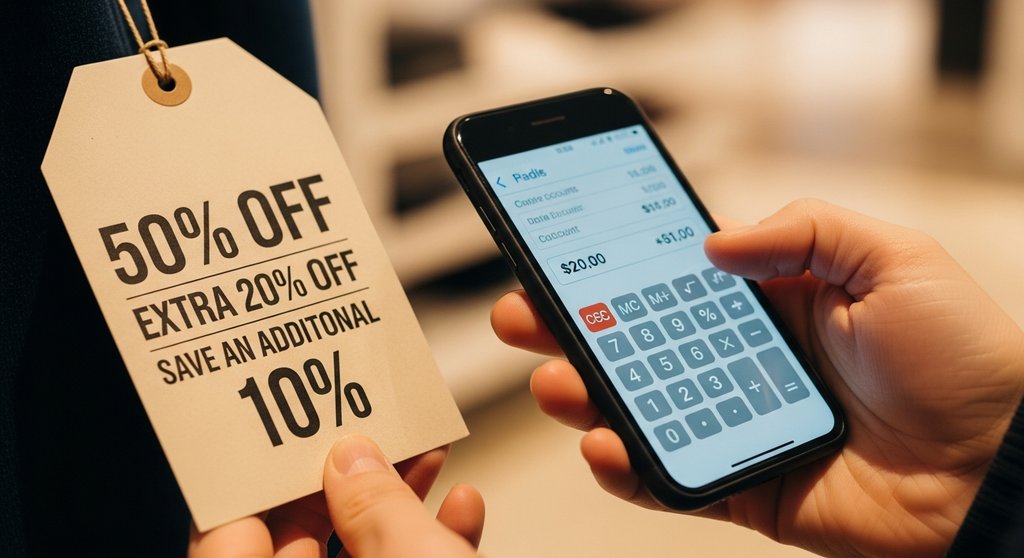
Why Your 20% Discount Is Never Really 20% Off
That bold '20% OFF' sign feels like a win, but the number your receipt shows often tells a different story.
The stacking discount illusion that costs shoppers real money
Retailers love to advertise 'an extra 20% off already-reduced items.' Shoppers mentally add the discounts, assume 50% total savings, and feel smart. But two successive percentage cuts do not add up. A 30% discount followed by an additional 20% off gives you 44% total, not 50%. On a $200 jacket, that gap is $12 you thought you were saving but weren't.
The math is straightforward. First discount: $200 times 0.70 equals $140. Second discount: $140 times 0.80 equals $112. Total savings: $88, which is 44% of the original price. If you expected 50% off, you were mentally handing the store an extra $12 without realizing it.
Percentage increase versus percentage point increase, a mix-up that moves markets
A savings account that goes from 2% APY to 3% APY has increased by one percentage point. But the interest rate itself rose by 50%. These two statements describe the exact same event, yet financial news outlets routinely conflate them. If your bank says your rate 'increased 50%,' that sounds enormous. If they say it 'rose one percentage point,' it sounds modest. Same fact, wildly different feelings. Try the percent calculator to see your own numbers.
This confusion matters most when you're comparing investment returns, loan rate changes, or pay rises. A salary bump from $60,000 to $63,000 is a 5% raise. If a colleague got a bump from $80,000 to $84,000, their percentage increase is only 5% too, even though they pocketed an extra $4,000. Percent of what is always the question worth asking.
Tipping, splitting, and the 15-18-20 range people guess wrong
Most people estimate tips by rounding the bill and eyeballing a fraction. On a $47.80 dinner tab, 18% should be $8.60. Mental shortcuts often land people at $7 or $9 with no real feel for the gap. Over a year of regular restaurant visits, loose tip math adds up to either undertipping service staff or consistently overpaying without intending to.
The fastest accurate method is the 10% anchor. Ten percent of $47.80 is $4.78. Half of that is $2.39. Add them for 15%: $7.17. For 20%, simply double the 10% figure: $9.56. For 18%, take 20% and subtract a tenth of that: $9.56 minus $0.96 equals $8.60. Still, when the bill has alcohol, split checks, and a complex group order, a quick percentage calculator keeps everyone honest and the math effortless.
When election season turns percentage statistics into weapons
Crime statistics, polling numbers, and budget debates all lean heavily on percentages, and the framing can be deliberately misleading. 'Crime rose 100%' in a small town might mean it went from two incidents to four. A 100% increase sounds catastrophic; the raw number reveals something far more routine. Scale matters as much as the percentage itself.
The same trick runs in reverse. A program that costs $500 million might be described as 'less than 0.01% of the federal budget,' which is technically accurate and also designed to make the number feel negligible depending on the speaker's agenda. Whenever you see a percentage quoted without the underlying base number, that is worth flagging. Use a straightforward percent calculator to reverse-engineer the actual figures and judge claims on their own terms.