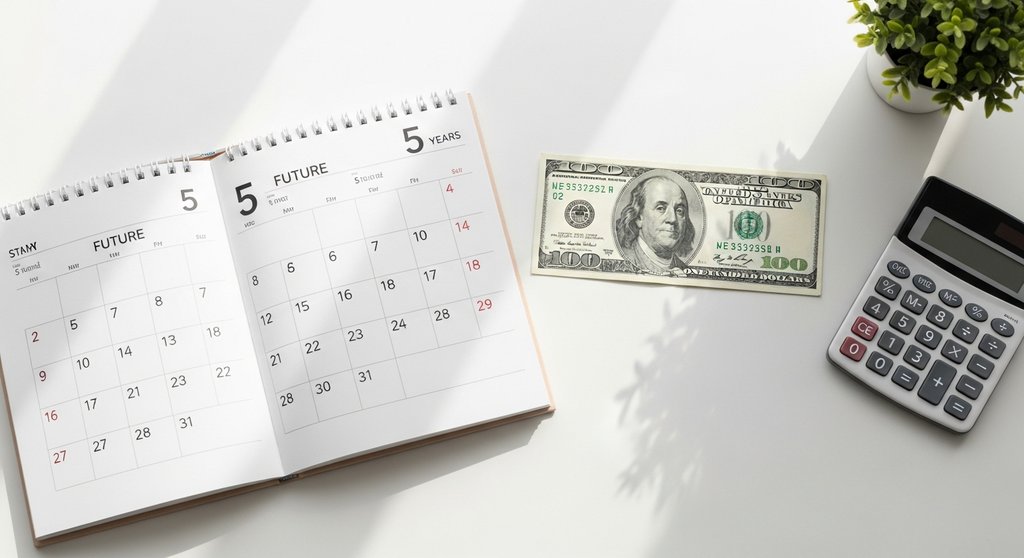
Why a $10,000 Promise Five Years Away Is Worth Less Today
A guaranteed $10,000 payment arriving five years from now sounds great until you run the numbers and realize you might be accepting far less than you think.
The Misconception That Costs People Real Money
Most people treat a future dollar as roughly equal to a current dollar. That instinct is understandable but wrong, and it shows up in costly decisions: accepting a structured legal settlement instead of a lump sum, agreeing to deferred compensation without checking its real value, or buying an annuity without comparing it to alternatives.
The core principle is straightforward. Money today earns a return. So a dollar you receive in the future is worth less than a dollar you hold right now, because you miss out on everything that dollar could have earned in the meantime. That gap is not trivial. At a 6% discount rate, $10,000 five years from now is worth only about $7,473 today. That is a real $2,527 difference in purchasing power.
How the Discount Rate Changes Everything
The discount rate is the variable most people ignore, and it swings the answer dramatically. Use a 3% rate and that same $10,000 future payment is worth about $8,626 today. Use 8% and it drops to roughly $6,806. The rate you choose should reflect what you could realistically earn elsewhere, which makes the current interest rate environment directly relevant. Try the present value calculator to see your own numbers.
In 2020 and 2021, savings accounts and Treasury bonds paid close to zero. Back then, a low discount rate made sense, and future payments looked nearly as valuable as current ones. With short-term rates now sitting above 4% in many countries, future promises are worth meaningfully less than they were a few years ago. Anyone renegotiating a payment plan, evaluating a buyout offer, or reviewing a pension right now should be recalculating with an updated rate.
Three Practical Scenarios Where This Math Actually Matters
First, legal settlements. Plaintiffs are often offered either a lump sum or structured payments over several years. A settlement that pays $5,000 per year for five years looks like $25,000 total. At a 5% discount rate, though, the present value of that stream is closer to $21,648. The attorney takes a cut of the total, not the present value, so understanding the difference protects you.
Second, home seller financing. If you sell property and carry back a note, say you accept $50,000 payable in three years, you need to know what that note is actually worth today before pricing your home. Third, retirement buyouts. Companies increasingly offer employees a choice between staying in a defined benefit pension and taking a lump-sum buyout. The company calculates that buyout using its own discount rate assumptions, which are not necessarily favorable to you. Running your own numbers gives you a real baseline for negotiation.
A present value calculator makes each of these scenarios fast to model. Plug in the future amount, expected years, and your chosen discount rate, and you get a defensible current-value figure in seconds. No spreadsheet required.
Choosing a Discount Rate That Reflects Your Actual Alternatives
There is no single correct discount rate. For a conservative investor, using the current yield on a 5-year Treasury note is reasonable. For someone who expects to invest in a diversified stock portfolio, a rate between 6% and 8% is common. What you should avoid is using 0%, which is what most people implicitly do when they evaluate future payments without any calculation at all.
If you are evaluating something with guaranteed payments, like a government pension or an insured annuity, use a lower rate since your alternative would likely be a low-risk bond. If the payment carries any default risk, bump the rate up to account for that uncertainty. The rate is a judgment call, but making an explicit choice is far better than ignoring the concept entirely.