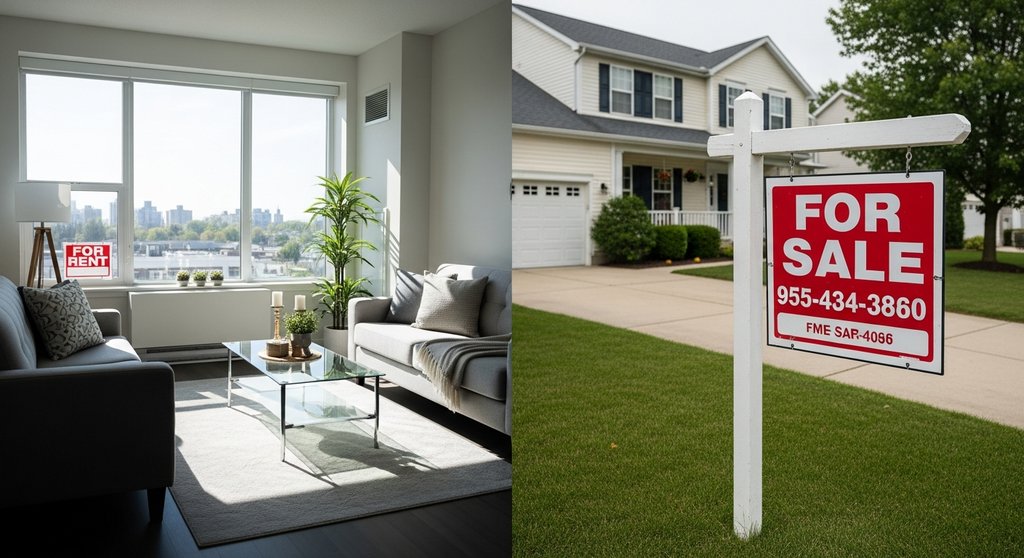
Renting Still Beats Buying in 2025 for Many Americans
The old rule that buying always beats renting no longer holds the way people think it does, especially with 30-year mortgage rates still hovering above 6.5%.
Why the "Buy as Soon as You Can" Rule Broke Down
For decades, financial advice pointed one direction: stop paying your landlord's mortgage and start building equity in your own home. That logic made sense when rates sat at 3% and home prices rose steadily. Today, buying the same house costs roughly 60% more per month in interest alone compared to 2020, which is a gap no amount of equity-building instinct can paper over.
A household earning $90,000 a year and renting a $2,200 apartment in a mid-sized city may actually come out ahead financially over a 5-year horizon compared to buying a comparable $380,000 home at 6.8%. The numbers depend on local property taxes, expected appreciation, and how long you actually stay, but the point is the math is no longer obvious.
The Two Costs Most Buyers Forget to Count
People often compare their monthly rent against a projected mortgage payment and call it a day. That misses two categories that routinely add 2-4% of a home's value per year: maintenance and transaction costs. A roof repair, a failed HVAC unit, or a water heater replacement can each run $4,000 to $12,000. Renters transfer that risk to landlords. Try the rent vs buy comparison tool to see your own numbers.
Transaction costs are the quieter drain. Between closing costs on the way in, around 2-5% of the purchase price, and agent commissions on the way out, historically 5-6% of the sale price, a buyer who sells in three years may have paid $30,000 or more in pure friction costs on a $400,000 home. Staying put for 7-plus years is when ownership usually starts winning on a net-worth basis.
A rent vs buy calculator that accounts for all these variables gives a far more honest picture than a simple mortgage-versus-rent comparison. Plugging in your local property tax rate, expected annual appreciation, and planned years in the home can shift the breakeven point by two to four years in either direction.
Running the Real Numbers on a $420,000 Home in 2025
Take a concrete example. A $420,000 home with 10% down at 6.75% produces a principal-and-interest payment of about $2,456 per month. Add property taxes at 1.2% annually ($420/month), homeowner's insurance ($120/month), and average maintenance at 1.5% ($525/month), and the true monthly cost reaches roughly $3,520. A comparable rental in the same neighborhood at $2,400 per month looks a lot more competitive.
The buyer's advantage kicks in through equity accumulation and potential appreciation, but only if the home gains value and the owner stays long enough. At a modest 3% annual appreciation, that home is worth about $486,000 in five years, a gain of $66,000. Subtract cumulative extra housing costs of around $67,200 over the same period and the financial edge nearly disappears, before factoring in the opportunity cost of the down payment invested elsewhere.
These figures shift dramatically based on local market conditions. Someone buying in a high-appreciation metro like Austin or Nashville faces different math than a buyer in Cleveland or Pittsburgh. That is exactly why plugging your specific inputs into a rent vs buy comparison tool is worth the ten minutes before making a seven-figure lifestyle decision.
When Buying Still Wins Decisively
None of this means renting is always smarter. If you plan to stay in one place for 10 or more years, own a stable income, and can put 20% down to avoid PMI, buying builds substantial net worth that renting cannot replicate. Forced savings through equity is a real psychological and financial benefit for many households.
Buying also wins when local rents are inflating fast and rent control is absent. A fixed-rate mortgage payment is locked in for 30 years; a landlord can raise your rent annually. In cities where rents have climbed 30-40% since 2020, locking in today's mortgage payment may look like a bargain by 2030 even if rates feel painful now.