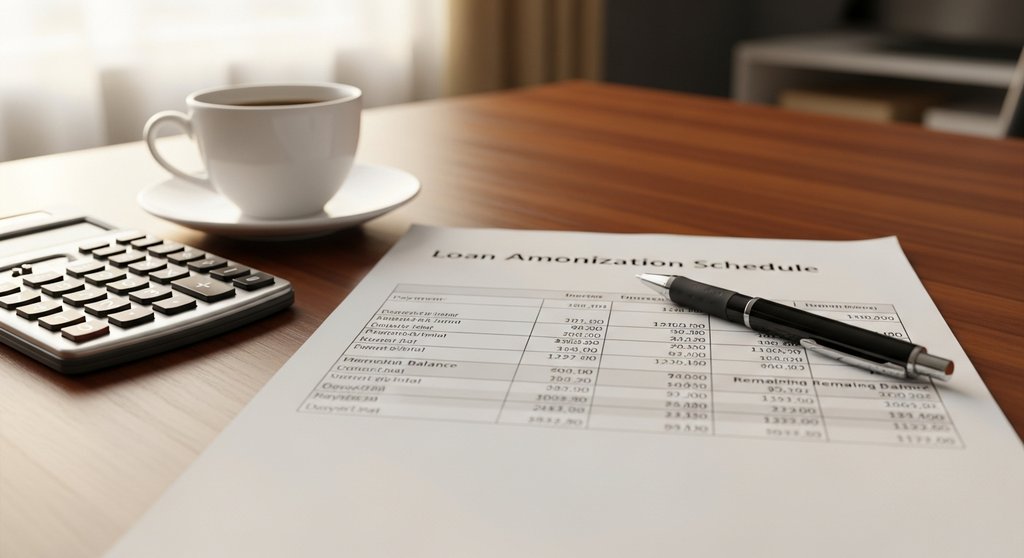
Why Your Loan Balance Drops So Slowly at First
You've been making on-time payments for two years, yet your loan balance barely budged, and there's a mathematical reason for that.
The Interest-First Trap Most Borrowers Miss
Every fixed-rate loan payment splits into two buckets: interest owed for that month and principal reduction. The split is not 50/50. On a $25,000 auto loan at 7% APR over 60 months, your very first payment of roughly $495 sends about $146 to principal and $146 to interest. Wait, those actually are close, but stretch that to a 30-year mortgage at 6.5% on a $350,000 home and the story flips hard.
On that mortgage, the first payment of around $2,212 sends only $312 to principal. The other $1,896 goes straight to interest. You need to reach payment 153, which is more than 12 years in, before principal finally overtakes interest in a single payment. That front-loading is not a bank trick; it is just how simple interest on a declining balance works.
How the Math Actually Builds an Amortization Schedule
Each month, the lender multiplies your remaining balance by the monthly interest rate (annual rate divided by 12). For a 6.5% loan, that is 0.5417% per month. The result is the interest due. The remainder of your fixed payment chips away at principal. Because the balance is highest in month one, so is the interest charge. As principal shrinks, interest shrinks with it, and the principal portion of each payment grows. Try the loan payment breakdown tool to see your own numbers.
This compounding math means paying an extra $200 per month on that $350,000 mortgage shaves roughly 5.5 years off the loan and saves close to $80,000 in total interest. The savings are not linear; they are exponential, because every extra dollar paid early prevents months of future interest calculations on that same dollar.
A loan amortization calculator lets you model exactly this, showing a full payment-by-payment breakdown so you can see the crossover point and the true cost of carrying the loan to term.
The Refinance Decision Resets the Clock
Refinancing is tempting when rates drop, but it restarts the amortization schedule from month one. If you are seven years into a 30-year mortgage, you have already paid through the most interest-heavy phase. Refinancing into a new 30-year loan, even at a lower rate, can result in paying more total interest over the full life of both loans combined.
A realistic comparison requires looking at your remaining balance, the new rate, closing costs (typically 2% to 5% of the loan), and how many months it takes to break even. Running the scenario through a loan payment breakdown tool before signing any refinance paperwork is the only way to see the full picture, not just the lower monthly bill.
One Number That Changes Everything: Your Payoff Date
People fixate on monthly payment size when shopping for loans, but total interest paid over the life of the loan is often three to four times more revealing. A $30,000 personal loan at 11% over 5 years carries a $652 monthly payment and roughly $9,100 in total interest. Stretch that same loan to 7 years to cut the payment to $516 and total interest jumps to $13,300.
The $136 monthly savings costs an extra $4,200 in interest. That trade-off is completely invisible unless you work through the schedule. Before you take the longer term to ease cash flow, confirm you actually come out ahead after accounting for what you hand back to the lender in years six and seven.