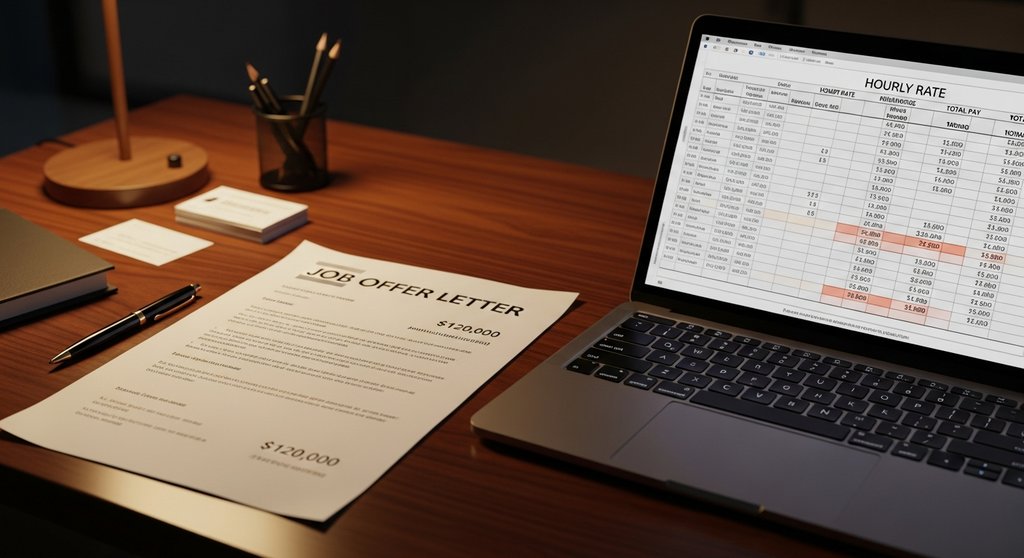
Your Salary Sounds Great Until You Do the Math
That annual salary figure on your offer letter can look a lot less impressive once you account for the hours you actually work.
Why $60,000 a Year Is Rarely $28.85 an Hour
The standard salary-to-hourly conversion assumes 40 hours a week for 52 weeks, which gives you 2,080 working hours per year. Divide $60,000 by 2,080 and you get $28.85 an hour. Clean, simple, and almost certainly wrong for most salaried workers.
The problem is that salaried employees are rarely paid overtime, yet many routinely work 45, 50, or even 55 hours a week. If you're pulling 50 hours on a $60,000 salary, your real hourly rate drops to around $23.08. That's a 20% cut in effective pay compared to what the math suggests on paper.
The Unpaid Lunch Break Effect Nobody Talks About
Most salaried employees take a 30-minute or 60-minute lunch break that isn't counted in productivity discussions but absolutely factors into the hours they spend away from home. A worker who clocks in at 8 a.m., takes an unpaid lunch, and leaves at 6 p.m. is at the office for ten hours, not eight. Try the salary to hourly calculator to see your own numbers.
Over a full year, five extra unpaid hours per week adds up to 260 hours. On a $70,000 salary, that reduces your true hourly rate from $33.65 to about $27.13. Before you negotiate your next job offer, a salary to hourly calculator can surface exactly what that package means in real, per-hour terms.
This matters even more for remote workers who blur the lines between work hours and personal time. If Slack messages at 9 p.m. are part of the job, those minutes count.
How a Side-by-Side Comparison Changes Negotiations
Say you're weighing two offers: a $75,000 salaried role with a reputation for long hours versus a $34-per-hour contract position with a firm 40-hour week. On the surface, the salary looks safer. But if the salaried role regularly runs 50 hours, the effective hourly rate is about $28.85, nearly $5 less than the contract gig.
Contract rates also don't include employer-paid benefits, so the comparison is never perfectly one-to-one. Still, knowing the hourly equivalent of a salary offer gives you a concrete starting point instead of comparing two completely different units of measurement. It also tells you immediately when extra hours are erasing what looked like a raise.
The same logic applies when switching from hourly to salaried work. An employee earning $22 an hour with consistent overtime at time-and-a-half might actually take a pay cut accepting a $50,000 salary, even though $50K sounds like a step up.
A Quick Formula You Can Run in 30 Seconds
Take your annual salary. Divide it by the number of weeks you actually work (subtract vacation if you want precision). Then divide that result by the real hours you put in each week, not just the contracted 40. The two-step division is the whole calculation.
For example: $80,000 divided by 50 working weeks equals $1,600 per week. Divide $1,600 by 48 actual hours and you land at $33.33 per hour. That same worker might have assumed they were earning $38.46 an hour based on the standard formula. A difference of five dollars per hour across a full year is $12,000 in effective compensation that simply disappeared into unpaid extra work.
Getting this number right before accepting an offer, asking for a raise, or comparing freelance rates to a full-time package is one of the simplest ways to avoid underselling your time.