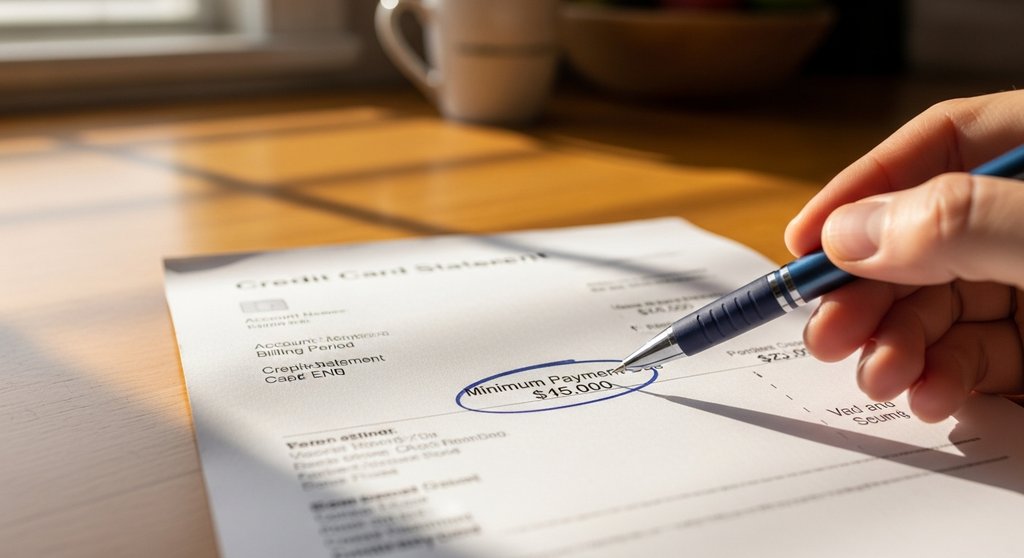
Why Paying Just the Minimum Is a Debt Trap
That minimum payment on your credit card statement is not generosity from your lender; it is a mathematically precise way to keep you in debt as long as possible.
What the Minimum Payment Line Hides from You
Credit card issuers typically set minimum payments at 1% to 2% of your outstanding balance, plus interest charges. On a $5,000 balance at 22% APR, that works out to roughly $110 per month. Sounds manageable, right? The catch is that nearly $92 of that first payment goes straight to interest, leaving only $18 chipping away at principal.
At that rate, paying off $5,000 takes over 20 years and costs more than $7,800 in interest alone. The total repayment exceeds $12,800 on a debt you originally spent $5,000. Most people have no idea the math works out this way because card statements are not required to show the full cost of minimum-only payments in plain terms.
How a Fixed Extra Payment Changes the Entire Picture
Adding even $50 extra per month to that same $5,000 balance slashes the repayment timeline from 20-plus years to roughly 4 years and cuts total interest from $7,800 to about $1,400. That is $6,400 saved for a commitment of $50 a month. The gains are nonlinear: the earlier you increase your payment, the bigger the effect, because interest compounds on whatever principal remains. Try the debt payoff calculator to see your own numbers.
This is where a debt payoff calculator becomes genuinely useful rather than just a curiosity. You can enter your exact balance, interest rate, and current minimum, then slide the monthly payment up by $25 or $50 increments and watch the payoff date collapse. Seeing the numbers move in real time makes the abstract concept of compound interest feel immediate and concrete.
The calculus shifts again if you carry multiple debts. The avalanche method, targeting the highest-rate debt first, typically saves the most money. The snowball method, paying off the smallest balance first, builds psychological momentum. Either way, running the numbers for each account separately shows you where each extra dollar has the most impact.
Why Right Now Is a Particularly Bad Time to Coast on Minimums
Average credit card APRs climbed above 21% in 2023 and have stayed elevated. The Federal Reserve held rates high longer than many economists predicted, and while rate cuts have begun, card issuers have been slow to pass those reductions to borrowers. That means revolving balances carried today are still accruing interest at historically steep rates.
The practical consequence: every month you stay at the minimum, you are losing more ground than you would have at the 15% average rates common a decade ago. A $3,000 balance at 21% that you pay off in 12 months costs about $350 in interest. Stretch that to 36 months on minimums and the interest bill triples. The rate environment makes speed of repayment more valuable, not less.
Running Your Own Numbers Takes Less Than Two Minutes
Pull out your most recent statement and note your balance, APR, and the minimum payment due. Then use the debt payoff calculator to set a target payoff date, say 24 months, and let it tell you exactly what monthly payment gets you there. Most people are surprised to find the required payment is far smaller than they assumed.
If the number still feels tight, try the reverse: enter what you can realistically pay and see the payoff date. Even knowing that paying $175 instead of $110 cuts 14 years off your timeline can shift how you prioritize that amount in your monthly budget. The goal is to make the cost of inaction visible, because once it is, the minimum payment line on your statement looks very different.