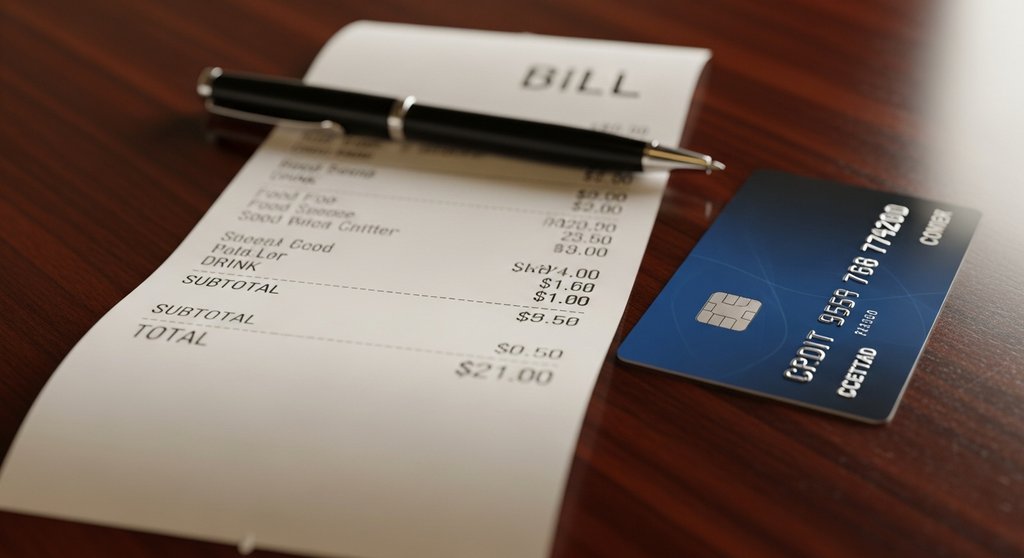
Should You Tip on the Pre-Tax or Post-Tax Total?
One small habit at the restaurant table can quietly add up to hundreds of dollars a year, and most diners never think about it.
The number on your check that most people ignore
When a bill arrives, most people glance at the total and calculate a percentage from there. That total almost always includes sales tax, which ranges from 0% in states like Montana and Oregon to over 10% in parts of Illinois. Tipping on that inflated number means you are effectively tipping on a government fee, not on the service or food.
The difference is small on a single meal but it compounds fast. Say your food and drinks come to $60 before tax, and your city adds 9% sales tax, bringing the bill to $65.40. A 20% tip on the pre-tax amount is $12. The same 20% on the post-tax total is $13.08. That gap is just over a dollar per meal, but for a family eating out twice a week, it works out to roughly $110 a year going to tipping math rather than rewarding great service.
What etiquette guides and servers actually say
Emily Post and most traditional etiquette sources have long recommended tipping on the pre-tax subtotal. The logic is clean: you are compensating someone for a service, not for the local tax code. Restaurant workers themselves tend to be practical about it since the final tip amount matters more than the calculation method behind it. Try the restaurant tip calculator to see your own numbers.
That said, the post-tax habit has become so common in the United States that many servers expect it. Digital payment terminals now default to presenting tip buttons as percentages of the post-tax total, quietly nudging every diner toward the higher number without any announcement. If you tap "20%" on a Square or Toast terminal, you are almost certainly tipping on the full post-tax bill.
How tip prompts on payment terminals shifted the default
Point-of-sale systems changed tipping behavior more than any cultural shift did. Pre-calculated tip buttons, which became standard in the early 2010s, removed mental arithmetic from the equation entirely. The downside is that customers lost visibility into the base number those percentages are being applied to.
A $48 pre-tax dinner at a restaurant in Chicago, with 10.25% local tax, becomes $52.92 on the terminal. The "18%" button then generates a $9.53 tip instead of $8.64. Neither server nor diner notices a problem because the process feels automatic. This is exactly the kind of scenario where running quick numbers with a dedicated tip calculator before you hand over your card can save you from tipping more than you intended, or conversely, less than you wanted.
When tipping above 20% actually makes sense
The pre-tax vs. post-tax debate matters most in high-tax jurisdictions and for larger group bills. For a solo lunch under $20, the difference is genuinely trivial. But for a dinner party of six with a $300 food bill, tax can push the total past $330, and the gap between methods exceeds $6 on a standard 20% tip.
Tipping higher than 20% is increasingly common in cities with high costs of living, where servers rely on tips to meet rent. If you are intentionally tipping 25% or 30% to reward exceptional service, knowing your base number lets you hit that target precisely rather than guessing. The fastest way to do that math at the table, including splitting the total across multiple people, is to use a restaurant tip calculator before you put down your card.