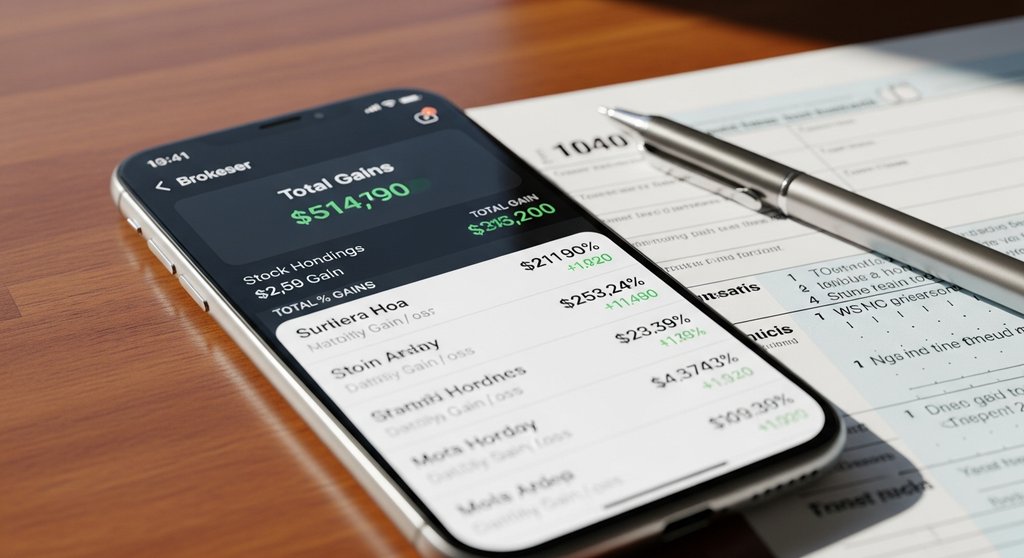
Selling Stocks This Year? Short vs. Long-Term Gains Matter
One extra day of holding an investment can drop your tax rate from 37% to 20%, and most people selling stocks this year don't realize how close they might be to that line.
The One-Year Rule That Changes Your Tax Bill Completely
The IRS draws a hard line at 12 months. Sell a stock, fund, or piece of real estate within 365 days of buying it and your profit gets taxed as ordinary income, meaning rates from 10% all the way to 37% depending on your bracket. Wait one more day past that anniversary and the gain qualifies as long-term, taxed at 0%, 15%, or 20%.
For a single filer earning $80,000 a year who realizes a $15,000 gain, the short-term bill could be $3,600 (at 24%). The long-term bill would be $2,250 (at 15%). That $1,350 difference comes entirely from timing, not from any change in the investment itself. Multiply that across a larger portfolio and the stakes grow fast.
Why Investors Miscalculate Their Holding Period
Most people assume they can count months rather than days, which leads to costly mistakes. If you bought shares on March 15, 2024, the one-year mark is March 15, 2025, not March 1 or the end of Q1. Brokerage statements sometimes show the purchase date in a format that's easy to misread, especially after stock splits or dividend reinvestments, which reset the clock on new shares. Try the capital gains tax calculator to see your own numbers.
Reinvested dividends are a particularly sneaky trap. Every automatic reinvestment creates a new lot with its own purchase date. Sell a fund position in February thinking it's all long-term, and you may find that shares bought via reinvestment in September are still short-term. Tax-loss harvesting adds another layer; if you sell at a loss and repurchase within 30 days, the wash-sale rule disallows the loss and adjusts your cost basis, changing the gain calculation entirely.
Running the numbers before you sell, not after, is the move. A capital gains tax estimator lets you punch in your purchase price, sale price, holding period, and income to see the actual after-tax proceeds in seconds.
How the 0% Long-Term Rate Applies to More People Than You Think
For 2024, single filers with taxable income up to $47,025 pay zero federal tax on long-term capital gains. Married couples filing jointly get a threshold of $94,050. That means a retired couple drawing down a modest income could sell appreciated index funds and owe nothing federally, provided their total taxable income stays under that ceiling.
This creates a real planning opportunity. If you have a year with lower income, such as a gap between jobs, early retirement, or a sabbatical, it may be worth accelerating asset sales to capture the 0% bracket before your income rises again. The strategy is sometimes called gain harvesting, and it works in the opposite direction from the more familiar tax-loss harvesting. You want to realize gains intentionally while the rate is low, resetting your cost basis upward so future appreciation is taxed on a smaller amount.
State Taxes Are the Bill Most Calculators Ignore
Federal rates get most of the attention, but state taxes can add a significant layer. California taxes all capital gains as ordinary income, with a top rate of 13.3%. New York adds up to 10.9%. Meanwhile, Florida, Texas, and several other states collect zero state income tax on gains. A $50,000 gain for a California resident in the top bracket could mean roughly $6,650 in state tax on top of the federal bill.
High-income sellers also face the Net Investment Income Tax, a 3.8% federal surcharge that kicks in when modified adjusted gross income exceeds $200,000 for single filers or $250,000 for joint filers. That brings the effective federal long-term rate for top earners to 23.8% before any state taxes. Getting a complete picture means accounting for all three layers: federal, NIIT, and state.